
Mountain biking
Flow Trails by Mountain Bike: Definition, Spirit, and Why Everyone's Talking About It
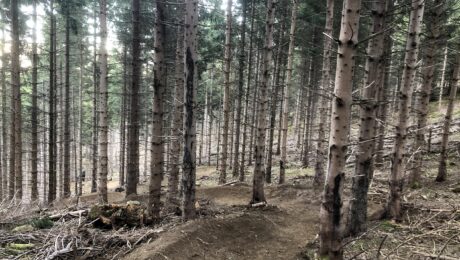
In the world of modern mountain biking, one word keeps coming up: Flow Trail.
Alpine bike parks, mountain bike resorts, YouTube videos, North American destinations or newly developed trails… “flow” has become an essential reference.
But what exactly is a flow trail?
Why do some trails immediately make you want to "let go of the brakes" while others require much more committed riding?
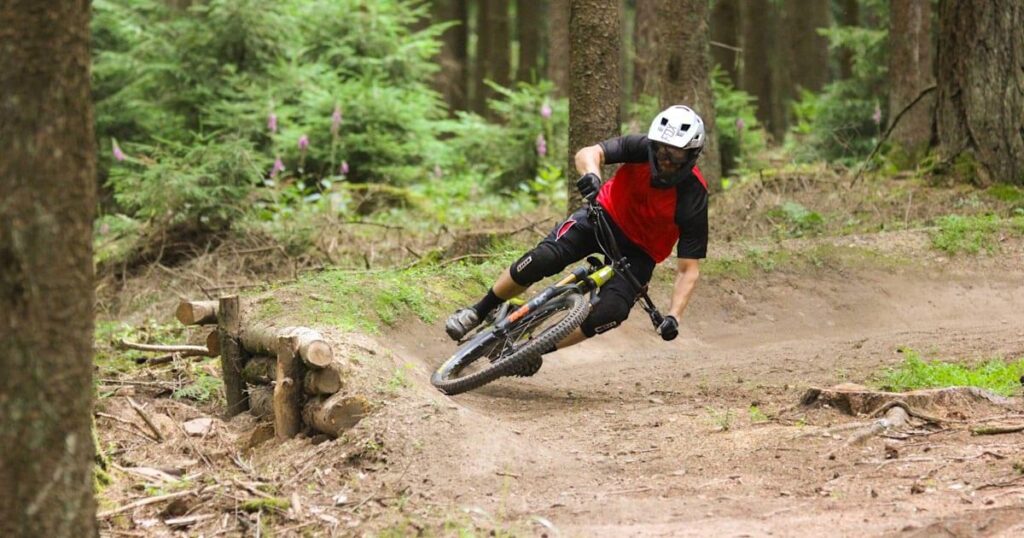
Definition of a Flow Trail
In the world of mountain biking, a Flow Trail (or simply “flow”) refers to a track designed to be:
- fluid,
- rhythmic,
- playful,
- intuitive to ride.
The principle is simple:
The bike should "flow" naturally into the terrain.
The rider then continued:
- the turns,
- the compressions,
- roller skates,
- the supports,
- sometimes the jumps,
with minimal braking and very little acceleration.
The word “flow” does not correspond to an official rating like green, blue, red or black.
He describes rather a design philosophy and a feeling of piloting.
A trail bike designed for the pleasure of riding
A good flow trail allows the rider to maintain:
- speed,
- rhythm,
- fluidity,
- a feeling of ease,
- immediate pleasure.
Unlike a very natural or technical trail, a flow trail generally seeks to avoid:
- the abrupt breaks,
- technical pitfalls,
- the inconsistent areas,
- permanent braking.
The terrain then becomes more “readable” and more mentally accessible.
Flow Trail vs Technical Trail
Two main types of trails are often contrasted:
The Flow Trail
- fluid,
- player,
- modern,
- pace,
- modified to maintain speed.
The technical trail
- roots,
- stones,
- natural slope,
- pins tightly packed,
- crossings,
- greater technical commitment.
Neither is “better”.
These are simply two very different riding experiences.
The best mountain biking areas often combine:
- natural mountain trails,
- and more accessible and fun flow trails.
The characteristics of a true Flow Trail
A homogeneous terrain
A flow trail typically has:
- few aggressive stones,
- few brittle roots,
- a relatively consistent grip,
- a rolling surface.
The goal is to maintain speed without being "taken out" of the rhythm.
Banked turns (berms)
Berms are practically the signature of modern flow trail running.
These banked turns allow:
- to maintain speed,
- to link the curves naturally,
- to generate driving pleasure,
- to make the trail more intuitive.
Rollers and compressions
The terrain plays a central role.
We often find:
- roller skates,
- waves of terrain,
- compressions,
- small ground movements that can be pumped.
The rider can then:
- generating speed without pedaling,
- play with the terrain,
- “Pumping” the supports like in BMX or pumptrack.
Jumps that are often accessible
Modern trail running often incorporates:
- small tables,
- rideable gaps,
- double secure,
- jump options.
The general idea remains:
- to offer fun,
- without making trail running reserved for experts.
The “flow” does not define the level
One important point:
A flow trail can be green, blue, red, or even black.
The flow describes the smoothness of the trail, not its difficulty.
Example: Green/blue flow
- moderate slope,
- limited speed,
- avoidable jumps,
- Ideal for exploring and families.
Example: Red Flow
- high speed,
- strong support,
- larger tables,
- Stronger physical engagement.
Why flow trails are exploding in modern bike parks
Flow trails have become the flagship product of modern mountain biking destinations.
For what ?
Because they offer:
- immediate pleasure,
- a feeling of rapid progress,
- broad accessibility,
- high customer satisfaction.
It's today:
- the favorite track of many recreational riders,
- the most profitable track in terms of visitor numbers,
- often the gateway to modern downhill mountain biking.
Major destinations such as:
- Whistler,
- Squamish,
- modern alpine resorts,
- the new generation of bike parks,
have developed this concept extensively.
The flow trail: a philosophy, more than just a trail
A true flow trail is not simply a “shaped” track.
He must:
- maintain a consistent speed,
- remain intuitive,
- avoid inconsistent traps,
- to allow movements to be linked together naturally.
Otherwise, the riders will probably talk about:
- jump line,
- of a prepared track,
- of DH,
- or simply a “shaped” track.
Flow is first and foremost a feeling.
How to describe a Flow Trail on a mountain biking website
Some examples of effective formulations:
Accessible version
A smooth and fun trail alternating between banked turns, rollers, and fast sections. Ideal for linking curves with rhythm and fluidity without requiring high technical skill.
More modern version
Modern singletrack flow trail, designed to prioritize speed, riding pleasure and fluidity.
Version geared towards the general public
A playful and fast track with many berms, clear terrain and natural transitions accessible to a wide audience.
Why is the flow so popular?
The success of the flow trail comes from a rare balance:
- sensation of speed,
- low stress,
- immediate pleasure,
- rapid progress,
- aesthetics of piloting.
Even an intermediate rider can feel like they are “riding well”.
And that's probably the whole strength of flow:
to make you want to do another run immediately.
- Published in Mountain biking
Mountain biking trail ratings in Saint-Lary – Aure Valley, Pyrenees
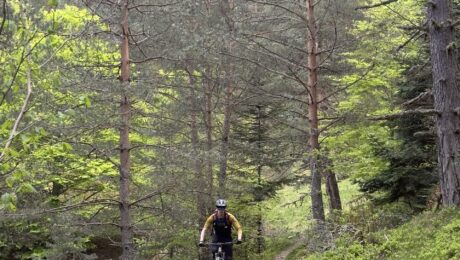
Technical level, commitment, flow, difficulty and exposure of mountain bike trails.
Mountain biking is not just about the color of the trail.
Between a fun singletrack in the forest, a technical descent in the shale, a challenging enduro route or a great alpine crossing, the sensations and requirements can be totally different.
In Saint-Lary and the Aure Valley, the terrain is constantly changing:
Fir forests, fast tracks, Pyrenean scree slopes, tight switchbacks, high-altitude sections, natural paths or more modern and shaped trails.
The objective of our rating system is simple:
- to offer immediate reading; ;
- to remain understandable to the general public; ;
- to maintain real credibility for experienced riders.
The most effective choice is therefore a clear rating out of 5, inspired by real terrain and rider experience.
This method allows you to better choose your path based on:
- his technical level; ;
- his physical condition; ;
- his desire to fly; ;
- its level of commitment; ;
- the desired sensations.
Why is a proper mountain bike rating system essential in the mountains?
In the mountains, two "red" ski runs may have absolutely nothing in common.
A route can be:
- Not very physical but very technical; ;
- extremely fast-rolling but very challenging; ;
- technically accessible but long and arduous; ;
- very fluid but exposed to the void.
In the Pyrenees, the variety of terrain around Saint-Lary makes this precision essential.
A good rating allows you to:
- to avoid level errors; ;
- to improve security; ;
- to choose a suitable outing; ;
- to better prepare one's equipment; ;
- to progress gradually.
It's also a way to better understand the spirit of a trail run before committing to it.
Mountain biking technical level
The technical level represents the difficulty of piloting the terrain.
It notably takes into account:
- the slope; ;
- the obstacles; ;
- the stones; ;
- the roots; ;
- pins; ;
- the necessary precision; ;
- adhesion management.
Technical rating
1/5 – Very easy
Rolling terrain with little technical difficulty.
Suitable for beginner athletes and families accustomed to cycling.
2/5 – Easy to intermediate
A few simple obstacles and small technical sections.
It already requires a minimum level of proficiency.
3/5 – Advanced Intermediate
Varied terrain requiring good bike handling skills.
Trajectories are starting to matter.
4/5 – Technically demanding
Regular technical checks:
slope, stones, switchbacks, brittle terrain, steep sections.
5/5 – Expert
Expert piloting required.
Challenging terrain, demanding and sometimes very technically physical.
Mountain biking fitness level
The physical level represents the effort required to complete the route.
It takes into account:
- the distance; ;
- the difference in elevation; ;
- the duration; ;
- altitude; ;
- the difficulty of the climbs; ;
- the repetition of efforts.
Physical rating
1/5 – Accessible
A short outing accessible to all.
2/5 – Moderate
Reasonable effort with some uphill sections.
3/5 – Supported
Good physical condition recommended.
4/5 – Demanding
Long climbs or large elevation changes.
Managing significant effort.
5/5 – Very physical
Reserved for trained practitioners.
Long, alpine or very demanding outings.
Overall difficulty
The overall difficulty represents the general level of the course.
She mixes:
- technique; ;
- physical ;
- length ;
- mountain environment; ;
- overall intensity of the ride.
Overall difficulty rating
1/5 – Sports Beginner
Accessible with minimal cycling experience.
2/5 – Easy Intermediate
First real mountain sensations.
3/5 – Advanced Intermediate
A serious career path already requiring experience and consistency.
4/5 – Difficult
Requires expertise, experience and field management.
5/5 – Committed Expert
Mountain route reserved for experienced riders.
Commitment
Commitment represents the possible consequences of an error and the difficulty of "getting out" of the course.
This is an essential criterion in the mountains.
It takes into account:
- isolation; ;
- fatigue; ;
- the exhibition; ;
- access to emergency services; ;
- ongoing technical expertise; ;
- the difficulty of turning around.
Commitment quote
1/5 – Not very committed
Easy return and safe terrain.
2/5 – Light commitment
Some more isolated or technical sections.
3/5 – Mountain Commitment
Terrain requiring vigilance and independence.
4/5 – Strong commitment
Mistakes that can have real consequences.
5/5 – Very committed
Strong commitment to mountaineering.
Reserved for experienced riders.
Flow: the fluidity of the trail
The “flow” has become a major reference in the modern mountain biking world.
A trail with flow gives the feeling that the bike is "flowing" naturally:
- pace ;
- speed ;
- supports; ;
- turns; ;
- compressions; ;
- fluid sequences.
The rider brakes little and naturally maintains speed.
Flow quotation
1/5 – Not very fluid
A choppy and uneven journey.
2/5 – Some enjoyable sections
The rhythm remains discontinuous.
3/5 – Good flow
Good overall fluidity and consistent sensations.
4/5 – Very fun
A fast-paced, modern and playful trail run.
5/5 – Maximum flow
Continuous sensations and very high driving pleasure.
Exposure
The exposure represents the risk associated with the environment of the trail.
It does not correspond to pure technical difficulty, but to the possible consequences of a fall.
Criteria taken into account
- empty ;
- lateral slope; ;
- ravines; ;
- narrow passages; ;
- rocky environment.
Exposure levels
Weak
Little or no risk related to the surrounding terrain.
Average
Some passages require attention.
Forte
Presence of voids or exposed sections requiring skill and concentration.
Why is this rating system particularly useful in the Pyrenees?
The mountain biking routes around Saint-Lary and the Aure Valley offer exceptional diversity:
- bike park; ;
- enduro; ;
- e-MTB; ;
- natural singles; ;
- flow tracks; ;
- technical descents; ;
- Alpine routes.
The same rider can search for:
- a fun outing; ;
- high-level piloting; ;
- modern flow; ;
- a challenging mountain adventure.
This rating therefore allows:
- to better choose your route; ;
- to avoid unpleasant surprises; ;
- to adapt one's equipment; ;
- to improve the overall experience.
Our tips before you go for a ride
Even with a good rating, the mountains remain a demanding environment.
Before each outing:
- check the weather; ;
- adapt your equipment; ;
- drink enough water; ;
- bring a repair kit; ;
- charge your phone; ;
- Inform someone of your itinerary.
For the most challenging routes, the use of a GPS with GPX track is strongly recommended.
At the house of Evolution 2 Saint-Lary, It is possible to rent GPS bikes with pre-loaded mountain bike and road routes to ride more serenely in the Aure Valley and the Pyrenees.
Cycling in Saint-Lary: a complete mountain biking destination in the Pyrenees
Between bike park, natural enduro, e-MTB, flow trails and major mountain routes, Saint-Lary and the Aure Valley now offer one of the most varied mountain biking terrains in the Pyrenees.
The objective of this rating is simple:
helping you find the right ride, at the right time, with the right level of commitment.
Because a good trail run isn't just about difficulty:
It's primarily about pleasure, sensations and mountain experience.
- Published in Mountain biking
Choosing the right bicycle wheel axle.
There are different types of wheel axles on the market. Below you will find a guide explaining how to differentiate them.
Depending on the fork:
Rock Shox RockShox uses a 15mm axle on most of its forks, but downhill forks use a wider 20mm thru-axle. They use a standard length with a 1.5" pitch.
Fox Fox uses a 15mm axle on most of its forks, but the threads have a diameter of 14mm. They use a standard length with a 1.5 pitch.
Road Generally, road bikes with disc brakes use a 12 x 100 mm spacing. This doesn't necessarily mean you'll need a 100 mm thru-axle, as fork width varies between bikes. Furthermore, there's very little consistency between brands, so you should carefully check all dimensions. You'll likely need a 118 mm or longer thru-axle.
Depending on the context:
Mountain biking: Most cross-country, trail, and enduro bikes use 12x148mm spacing, also known as Boost spacing. Some bikes use the 12x157mm standard. Since frame width affects the driveshaft length and the widely adopted standard threading, you'll need to check the dimensions carefully. You'll likely need a 170mm or longer thru-axle.
Road bike Road bike frames typically use 12x142mm spacing, but this doesn't necessarily mean you'll need a 142mm axle, as the frame width affects axle length. You'll likely need a 160mm axle or longer.
Depending on the thread: The thread size is called the "pitch," and to determine the pitch, you count the number of threads in a 10 mm section. There are three main specifications for M12 shafts – fine, medium, and coarse.

Fine thread (M12x1.0): This fine thread is generally used with a conical (angled) washer under the head. Most through-bolts use flat washers. This standard is often called the Syntace standard.. 10 fillets correspond to 1.0p.
Medium thread (M12x1.5): This thread is the most common on frames and forks, but it is not universally used. Approximately 7 threads correspond to P1.5mm.
Coarse thread (M12x1.75): Some frame brands use a coarse thread to reduce the time required to unscrew a thru-axle. Slightly less than 6 fillets corresponds to P1.75
Double thread Some thru-axles, notably the Speed Release, use a fine, double-lead thread. This means there are twice as many threads, which speeds up the process of screwing the axle into the frame or fork. All Speed Release axles are used on frames and forks with an open dropout. Additionally, the axle is notched to prevent it from accidentally falling out.

- Published in Cycling equipment, BIKE, Road bike, Mountain biking
How to choose your cross-country mountain bike?

The defining characteristics of a cross-country mountain bike
A cross-country (XC) mountain bike is designed to perform well on fast, flowing loops. The climbs and descents come one after another. The rider focuses on achieving good efficiency and maintaining a fast pace throughout the ride. A cross-country racer finds as much joy in climbing as in descending.
The frames are built with steeper head tube angles (70-72 degrees) and reach (distance between the bottom bracket axle and the head tube axle) which benefit the rider's body position when climbing.
Cross-country (XC) frames can be hardtails or full-suspension designs. The travel of a cross-country mountain bike typically ranges from 80 to 120 millimeters.
These mountain bikes will be the lightest of the four categories, with an average weight between 8 and 11kgs.
The lighter the bike, the less energy it consumes on climbs and long distances.
Below are all the key points to consider when choosing your XC mountain bike, whether you are a beginner or not.
- Hardtail or full-suspension mountain bike?
- Aluminum or carbon fiber frame?
- The wheels
- The tires
- The fork
- The transmission
- The brakes
- Choosing the right XC mountain bike
Cross-country mountain biking (XC) is the name for a type of mountain biking. There are several variations. It all depends on the terrain you ride on, how often you ride, and the distance you cover.
The terrain is the first criterion that will determine the mountain bike you will need.
If you ride in the countryside or forest and mostly on flat terrain, you will need a cross-country mountain bike.
If you ride on hilly terrain, choose an all-mountain mountain bike.
If you want to descend winding mountain trails at full speed, you will need to choose an enduro mountain bike, and if your wish is to descend a mountain as fast as possible while making incredible jumps, a downhill mountain bike, also called DH or freeride, will be essential.
Depending on the terrain, two characteristics must be considered: the type of bike (hardtail or full-suspension mountain bike) and the suspension travel. The latter refers to the mountain bike's ability to absorb impacts of varying magnitudes. A mountain bike's suspension travel is always measured in millimeters.
Here is the "technical" distinction of mountain biking that can be made according to the practice:
- Cross-country mountain bike: Hardtail mountain bike with 100 or 120mm of travel; ;
- All-mountain mountain bike: Full-suspension mountain bike with 140mm of travel; ;
- Enduro mountain bike: Full suspension mountain bike with 160mm travel; ;
- DH mountain bike or freeride mountain bike: full suspension mountain bike with 180 or 200mm of suspension.
1. A hardtail or full-suspension cross-country mountain bike?

A hardtail cross-country mountain bike is equipped with front suspension only, while a full-suspension mountain bike has a suspension fork at the front and a shock absorber at the rear. It's about choosing the suspension best suited to your riding style and performance goals. The risk with a full-suspension mountain bike is that the suspension absorbs some of your pedaling energy.
If you're looking for a fast, responsive mountain bike to ride faster, compete in the World Championships, or win the French Mountain Bike Cup, you should choose a hardtail mountain bike. A cross-country hardtail will be lighter and more agile, especially on flat terrain, but also more efficient on climbs. It's the best mountain bike for achieving great performances and beating all your personal bests over short distances.
However, if you plan to participate in the Roc d'Azur, or more generally in events with longer mountain bike courses that demand sustained effort and high endurance, you'll need a full-suspension mountain bike. But be aware that you'll need to choose a cross-country full-suspension bike with limited travel, a lightweight design, and an effective anti-bob system. The budget will then be higher than for a hardtail mountain bike.
2. An XC mountain bike made of aluminum or carbon fiber?
This, of course, refers to the material that makes up the frame of your future mountain bike. Carbon fiber is lighter and stiffer than aluminum, but also more expensive. It's the frame's performance that matters. A carbon fiber frame is stiffer, more efficient when pedaling, and more comfortable. Carbon fiber absorbs vibrations, doesn't vibrate, and doesn't resonate. So yes, at first glance, an aluminum frame might seem more comfortable, at least at the beginning of a ride, but in reality, it's quite the opposite. Aluminum deforms more than carbon fiber, so it absorbs your pedaling energy. But there's something even worse… aluminum doesn't absorb vibrations. Aluminum vibrates and resonates! So on long rides, an aluminum mountain bike will be less comfortable and more tiring than a carbon fiber one.
But let's go further: the right frame is the one that offers the best possible performance while maintaining some vertical compliance to protect your back. There are many carbon and aluminum frames on the XC mountain bike market. You need to choose the frame with the right geometry and design.
Choose a semi-rigid carbon fiber frame with BOOST spacing that accepts 29-inch wheels. BOOST spacing is the current standard for wheel axle dimensions, resulting in increased stiffness: 15 x 100mm front axle and 12 x 148mm rear axle. The frame should be lightweight and stiff to provide optimal power transfer.
Be sure to choose a frame that fits you properly and then find the correct position. We strongly recommend a postural analysis to help you make the best adjustments.
3. What size wheels does your XC mountain bike have: 27.5″ or 29″?
In cross-country riding, 29-inch wheels have become the standard. Wheels with a 29-inch diameter offer better rollover, more momentum, and greater speed on rolling sections. 29-inch wheels are more enjoyable to ride and require less effort to accelerate. Once up to speed, a 29-inch mountain bike goes faster and further.
Opt for 29-inch diameter wheels, if possible made of carbon fiber (lighter and more responsive), in BOOST format for greater rigidity and equipped with a mounting bracket for brake discs (centerlock or 6 holes).
4. Your cross-country mountain bike tires
Next, you need to fit tubeless-ready tires. Tubeless tires are lighter, more durable, and above all, they offer better handling on the trail. Tire weight is important. The choice of rubber compound and tread pattern are also important. Your choice of XC mountain bike tires will also depend on the terrain and the weather.
5. The fork of your XC mountain bike
You need a lightweight, stiff fork with a handlebar lockout to prevent pedal bob on climbs. Your fork should also be BOOST compatible and accept disc brake calipers. Opt for an air fork with a hydraulic cartridge for more responsive suspension that can be adjusted according to the rider's weight. Coil spring forks are heavier and offer fewer adjustments. Your fork should have 100 or 120mm of travel.
6. The drivetrain of your cross-country mountain bike
Opt for a single chainring drivetrain, which is lighter and easier to handle. With a single chainring, there's less chain twist and shifting is smoother. Choose a chainring with a larger number of teeth for higher speeds, for example, 34 teeth. And select a cassette with a 10-50 ratio, for instance. The more teeth the largest cog has, the easier climbs will feel. It's best to choose a shifter from the same brand and in the same price range as your derailleur (and with the same number of speeds).
Don't forget to use clipless pedals. You'll be more efficient with better power transfer and the ability to pull up on the pedals. Professional cyclists push and pull on their mountain bike pedals.
7. Your XC Mountain Bike's Braking System
Hydraulic disc brakes are preferable. They offer better feel and responsiveness than mechanical disc brakes. And for your information, the larger the diameter of your discs, the more powerful your brakes will be.
8. Choosing the right cross-country mountain bike
We have tested many XC mountain bikes over the years: technologies and standards evolve regularly.
What matters most, even more than the weight of the mountain bike, is its handling on the trail, its pedaling efficiency, especially in XC. The two most important elements for a high-performing XC mountain bike are: the frame and the wheels.
Your mountain bike needs to be highly responsive and offer maximum efficiency. Choose a mountain bike frame with a tapered, stiff head tube, a rigid bottom bracket, and a stiff down tube to maximize power transfer to the lower part of the frame. Short chainstays are essential for improved handling and explosive acceleration. The wheels will also significantly impact your mountain bike's performance.
There are many mountain bike brands. The best-known are: BMC, Trek, Focus, Lapierre, Orbea, BH, Merida, Canyon, Specialized, Rockrider, etc. Our advice: don't skimp on the frame and wheels. The rest of the components are almost optional. Having a mountain bike with a Shimano SLX or XTR drivetrain won't really change how your bike handles, and certainly not your race time.
With all this information, what is the ideal cross-country/XC mountain bike?
A carbon hardtail mountain bike with 29-inch BOOST wheels and Tubeless Ready tires. An ultra-lightweight mountain bike with a pedaling-efficient frame for improved power transfer. A lightweight suspension fork with a center lockout. All this with hydraulic disc brakes and a lightweight 1x drivetrain.
Don't forget to choose the right XC mountain biking gear. Opt for lightweight and comfortable clothing. Also, remember to equip yourself with a helmet, mountain bike glasses, gloves, and shoes designed for XC mountain biking, ideally with stiff soles, or even carbon fiber for better power transfer.
HOW TO CHOOSE A CROSS-COUNTRY BIKE
SUITED TO HIS PRACTICE?
Cross-Country (or XC), a long-standing mountain biking discipline, encompasses very different realities depending on the level at which it is practiced. While increasingly technically demanding courses are common at the highest levels, XC can also be considered a leisurely ride at a brisk pace with no other goal than to exert oneself in a natural setting. Depending on this approach, the choice of bicycle will then vary considerably.
WHAT IS CROSS-COUNTRY / MARATHON?
Cross-country (or XC), which involves alternating climbs, descents, and rolling sections on natural trails or circuits of varying lengths, is the oldest discipline and still arguably the one with the largest following. It doesn't require any special infrastructure and can be practiced year-round in all regions.
Cross-country, the very essence of mountain biking, is accessible to all levels, whether for recreational riding in a touring spirit or for high-level competition. The ranges of bikes in this category are therefore very extensive in order to cover all situations, particularly in terms of the terrain of the region where you wish to ride, your riding style, and your budget.
WHAT FRAMEWORK FOR MY PRACTICE?
Before choosing a mountain bike frame, you must first determine your objective. While comfort and robustness are paramount for recreational riding, performance-oriented riders prioritize lightness and responsiveness—more so than in any other mountain biking discipline—to handle the demands of constant changes in pace. These factors, naturally influenced by your budget, will lead you to choose a steel or aluminum frame for recreational riding, and a carbon frame for performance.
Besides the choice of frame material, the other important decision to make is whether to choose a hardtail or full-suspension mountain bike. While suspension design has made enormous progress in recent years, virtually eliminating pedal bob and thus greatly reducing efficiency differences, some notable differences still remain. A hardtail model will be lighter, easier to maintain, and more affordable at the same price point. A full-suspension bike, on the other hand, will offer greater comfort, better traction, and improved shock absorption.
Finally, the last criterion to consider is wheel size: 26 inches for a more maneuverable and responsive bike, but which has practically disappeared from manufacturers' catalogs (now mainly reserved for juniors); 27.5 inches for a good compromise between responsiveness and ease of handling (ideal for people between 1.60 and 1.70 m tall); 29 inches for a faster-rolling bike with increased obstacle clearance (which can be considered for riders 1.70 m and taller). It should be noted that 27.5+ (27.5-inch wheels allowing for very wide tires) is a hybrid format offering more comfort and stability, but also versatility since many 27.5+ models can accommodate either 27.5+ or 29-inch wheels.
WITH WHAT EQUIPMENT?
Cross-country mountain bikes typically have relatively short suspension travel, generally ranging from 100 to 120 mm, and lockout options to ensure optimal performance on rolling terrain, climbs, and descents. This lockout can often be operated directly from the handlebars, saving every second.
In terms of drivetrain, the single chainring system (1x11 or 1x12 speed) is increasingly popular due to its lightness, simplicity, and efficiency. However, recreational cyclists will find a double or even triple chainring setup, paired with a 10 or 11-speed cassette, more suitable for greater versatility and more confidence on climbs.
The remaining components are generally quite similar across models, with disc brakes most often hydraulic, featuring 160 to 180 mm diameter rotors, and wheels increasingly compatible with tubeless/tubeless-ready tires, offering not only maximum puncture protection but also improved traction and greater comfort. Finally, high-end models may come equipped with a dropper seatpost, allowing riders to instantly find the ideal position, whether climbing or descending.
- Published in Cycling equipment, BIKE, Mountain biking
Giant Bike Technology
Giant is the world's leading manufacturer of performance bicycles.
Below you will find all the technologies used for muscle and electric bicycles.
GIANT MUSCLE BIKE TECHNOLOGY
ADVANCED COMPOSITE
Giant's high-performance carbon fiber material allows us to manufacture this frameset in our own composite factory. Thanks to advanced manufacturing techniques and materials, Advanced Composite frames offer maximum stiffness and comfort while remaining exceptionally lightweight.
ADVANCED COMPOSITE SL
Giant's high-performance carbon fibers are woven in our composite factory using our most advanced design and manufacturing methods, including: our unidirectional composite fiber technology that strengthens the material while reducing its weight; our nano-technology composite resin to improve impact resistance; and our fusion joining process for lighter and stronger frame junctions.
ADVANCED FORGED COMPOSITE
State-of-the-art high-pressure molding process enabling the production of complex-shaped carbon fiber components that are lighter, stiffer, and stronger than similar aluminum components.
ALUXX ALUMINUM
This extremely high-performance frame material is made of 6061 alloy for single butt tubes to obtain a lightweight and strong frame kit, suitable for different types of bikes and riding styles.
ALUXX SL ALUMINUM
This high-grade aluminum material, made from 6011 aluminum alloy, delivers a premium power-to-weight ratio. ALUXX SL frames feature a unique welding technology to provide the best possible riding experience.
ALUXX SLR ALUMINUM
This extremely lightweight aluminum is primarily composed of 6011 alloy and offers the best strength-to-weight ratio for Giant aluminum frames. The meticulous weaving of microscopic fibers, along with an advanced butt-jointing technique, results in tubes that are 20 % thinner and lighter than ALUXX SL tubes.
AEROSYSTEM SHAPING
The shapes of the tubes are defined from computational fluid dynamics (CFD) data and wind tunnel tests, which allow the shape of each tube to be optimized in order to obtain the best aerodynamic performance.
COMAX COMPOSITE
This exclusive blend of pure carbon fibers and fiber-reinforced polymers allows Giant engineers to design comfortable and high-performance frame kits, which provide a ride quality specifically adapted to Sport and Fitness use.
COMPACT ROAD DESIGN
When introduced by Giant in the 1990s with the Team Once, the Compact Road design revolutionized the feel and appearance of high-performance road bikes. A sloping top tube (from the head tube to the seat tube) creates smaller front and rear triangles, resulting in a lighter and stiffer bike. This design also makes it easier for riders of all sizes to find the perfect fit.
COMPLIANCE TUNED
A composite material weave and specific tube shapes, including ultra-thin flattened seat stays, a low junction between the seat stays and the seat tube, as well as thin and slightly curved fork legs, come together for a smooth and balanced ride, with reduced rider fatigue.
D-FUSE
The D-Fuse seatpost and handlebar were designed as a set, absorbing road imperfections and shocks to allow you to ride further and faster.
FLEXPOINT SUSPENSION

A proven single-pivot design that utilizes the flex of the junction between the rear stays and the seat stays to create a lightweight and robust suspension system, with 120 mm (4.7 inches) of rear travel.
FLEXPOINT PRO SUSPENSION

The FlexPoint Pro suspension was designed to meet the demands of competition without compromising on either weight or rear suspension performance. To achieve this, our development teams designed a kinematic system based on an Advanced Forged Composite link and a flexible connection between the chainstays and seatstays. By reducing the number of pivot points, the new FlexPoint Pro suspension is simpler and lighter while delivering exceptional performance.
FLIP CHIP – MAESTRO

Our Flip Chip technology allows you to easily and quickly adjust your bike's geometry to suit your riding style, intended use, and terrain. The Flip Chip is an eccentric system located on the upper linkage. It has a high and low position, varying the bottom bracket height and the seat tube and head tube angles.
FLIP CHIP – MAESTRO 3

This technology allows riders to quickly adjust the geometry and choose the rear wheel size (29 or 27.5 inches) according to their riding style and the terrain. It is available on bikes equipped with Maestro suspension. The adjustment modifies the seat tube and head tube angles and the bottom bracket height. The rear wheel size depends on the position of the flip chip located on the upper link.
FLIP-CHIP DROPOUT

The rear dropouts of the new Revolt feature a reversible Flip-Chip type shim system. Held by a 5mm Allen screw, the two eccentric shims can be flipped to vary the chainstay length in two positions and the bike's geometry according to its intended use.
INTEGRATED SEATPOST
Considered a key performance factor, the integrated seatpost makes it possible to lighten the bike by 45 grams compared to a standard composite seatpost, while improving aerodynamics and providing flexibility capable of damping vibrations on the road.
INTEGRATED SEAT POST CLAMPING SYSTEM
A lightweight and fully integrated seatpost clamping system provides effective clamping force, combining performance and aesthetics.
MAESTRO SUSPENSION

Four strategically positioned pivot points and two connecting rods work together to create a floating pivot point, for an active, efficient and independent suspension system.
Here is the Maestro suspension system in video. (manufacturer).
MEGADRIVE
The oversized downtube and top tube work in unison to provide maximum precision. The downtube is designed to offer unprecedented stiffness in the steering and pedaling areas.
OVERDRIVE 2
The most advanced headset technology ever on Giant bikes. Designed to allow for unparalleled steering precision, the oversized headset bearings (lower 1 1/2″, upper 1 1/4″) and the tapered fork steerer work together to provide optimal steering stiffness.
OVERDRIVE
Designed to improve the precision of the front end steering, this fork pivot technology uses oversized bearings in the headset (for road, lower 1 1/4″, upper 1 1/8″, and for off-road, lower 1 1/2″, upper 1 1/8″) as well as a tapered fork pivot, which work together to provide optimal steering stiffness.
OVERDRIVE AERO
Located within the head tube of the all-level Propel, the D-shaped fork steerer and dedicated spacers form an extremely aerodynamic system, facilitating access to cables and housing.
POWERCORE
The oversized section at the extreme end of the bottom bracket and chainstays features a perfectly integrated 86mm wide bottom bracket (92mm for mountain bikes). The asymmetrical chainstays provide added stiffness and improved stability.
RIDESENSE
Wireless data transmitter integrated into the rear stays of Giant and Liv bikes. This removable transmitter sends cadence and wheel speed information directly to your ANT+ compatible computer.
Ridesense Compatible
The frame allows for the installation of the RideSense sensor as well as all related equipment.
VARIANT SEATPOST
This exclusive seatpost design optimizes the balance between lightness and superior handling quality, thanks to a simple adjustment to improve the overall racing performance of the TCR road range.
VECTOR SEATPOST
This extremely aerodynamic, lightweight seatpost, made entirely of composite material, is specifically designed for road performance.
INTEGRATED VECTOR SEATPOST
This lightweight and aerodynamic all-composite seatpost is specially designed for road performance.
GIANT MUSCLE BIKE TECHNOLOGY
ENERGYPAK
The EnergyPak battery range integrates perfectly with your Giant bike. Available in Smart or classic versions, they offer different energy capacities to enhance your experience riding a Giant e-bike.
HYBRID CYCLING
Hybrid Cycling technology combines the power of electricity and pedaling power to create an e-bike experience that is as efficient, powerful, and natural as possible. It's a natural extension of the rider's power and sets Giant e-bikes apart from the competition. This system incorporates four key innovative technologies that work in conjunction with your body's power; it's a natural extension of your abilities.
RIDECONTROL CHARGE

The RideControl Charge combines everything on a single screen. It displays the battery level, assistance mode, speed, and distance of your ride. Its sleek design and large screen offer maximum readability. It can be easily charged via its USB port. The Walk Assist mode allows you to walk alongside the bike effortlessly.
RIDECONTROL DASH

This new console combines integrated handlebar controls with a color display. This provides easily accessible control buttons and displays essential ride information. The RideControl Dash can be connected to the Giant RideControl App and a compatible ANT+ heart rate monitor or display.
RIDECONTROL ERGO

The RideControl ERGO unit integrates seamlessly into the handlebars of your Giant e-bike. Intuitive and easily accessible, it features buttons that can be operated in all conditions with a simple press of the thumb. A bright LED system indicates the battery level and the selected assistance mode. The RideControl ERGO unit can be connected to a compatible ANT+, Bluetooth, or wired display.
RIDECONTROL ERGO 2

The new RideControl ERGO 2 handlebar control features large, easily accessible buttons. It provides access to essential functions on your Giant e-bike, and its bright LEDs indicate the battery charge level and the selected assist mode. The RideControl ERGO 2 can be connected to a compatible ANT+, Bluetooth, or wired display.
RIDECONTROL ERGO 3

This new handlebar control integrates seamlessly with the grips. Reversible, it can be installed on either the left or right side of the handlebar, depending on the user's preference. Its three buttons are easily accessible with the thumb, allowing users to change assistance modes and activate the walk assist function. The RideControl Ergo 3 is ANT+ and Bluetooth compatible and can connect to the Giant RideControl App or a compatible display.
RIDECONTROL EVO

The RideControl EVO boasts a cutting-edge design and aesthetics. Its clean, rounded edges give it an elegant look. The aluminum casing protects it from impacts, even on rough terrain, making it more durable. The RideControl EVO can be connected via Bluetooth by our dealers and recharged via USB. The Bluetooth connection ensures that your RideControl receives updates, so you always have the latest software version.
RIDECONTROL GO

Integrated and intuitive. The new RideControl GO is seamlessly integrated into the top tube of the new Reign E+. Protected in case of a fall, it's also splash and rain resistant. It provides easy access to essential ride information (battery level and assist mode). Its color LED display shows the assist modes and battery charge level, while the central button turns the bike on/off and changes assist modes.
RIDECONTROL ONE

The RideControl ONE system enhances your e-bike experience with its integrated control buttons, offering a clean, screen-free handlebar design. E-bikes equipped with the RideControl ONE system can be connected to the Liv and Giant e-bike apps.
RIDESASH EVO

The new RideDash EVO console now features a color screen offering improved readability of the displayed information. Seamlessly integrated into the center of the handlebars, it displays essential ride information such as speed, distance, battery level, and heart rate (with a compatible heart rate monitor). Connected to the Giant RideControl App, the RideDash console can also display additional information like call/email notifications or a navigation mode.
RIDESASH PLUS

For our e-bikes equipped with the RideControl One ANT+ controller or Smart Gateway technology, the RideDash Plus unit can be used as an additional display. It shows important information, including range, battery level, and the selected assist mode, as well as standard cycling data such as speed, distance, and trip information. The RideDash Plus offers a larger screen and a more modern design compared to the RideDash.
SMART ASSIST
Giant SyncDrive motors feature Smart Assist technology, which adapts the electric assistance to the rider's needs. Sensors collect data from the terrain and the rider. In Smart Assist mode, the interface analyzes this data and transmits it to the motor, which then instantly delivers the necessary assistance for a natural pedaling feel while maximizing battery life. If the situation demands it, the motor can deliver its maximum power in Smart Assist mode.
SYNCDRIVE PRO
The SyncDrive Pro motor, manufactured by Yamaha to Giant's specifications, is designed for high-performance riding. Giant has fine-tuned this motor to make it more powerful and enable a performance-oriented riding style. The lightweight and compact SyncDrive Pro motor is primarily found on Giant's high-performance electric bikes.
SYNCDRIVE PRO SYSTEM

The SyncDrive Pro system, powered by the new Shimano EP8 motor, is a custom 85 Nm drivetrain that delivers smooth acceleration on paved roads, gravel roads, or trails. You can change assist modes using the Shimano Di2 shifters, allowing for a clean cockpit setup without an additional control unit.
SYNCDRIVE SPORT
Combining the innovation and expertise of our manufacturing processes with a motor created by Yamaha allows cyclists to achieve a tenfold increase in capabilities. The SyncDrive Sport motor offers three assistance modes and is installed on e-bikes used for daily commutes as well as more demanding off-road rides. This compact, mid-range motor delivers a powerful maximum torque of 70 Nm and is widely acclaimed for its performance and reliability.
SYNCDRIVE LIFE
The SyncDrive Life motor is the ideal solution for e-bikes with step-through frames. This compact, mid-drive motor ensures perfect weight distribution, making your e-bike more stable and balanced. Its centralized mass allows for natural weight distribution both when riding and at a standstill, making it an excellent choice for recreational riders. With its smooth torque of up to 60 N·m (newton meters), you can climb hills and cover longer distances with ease.
SYNCDRIVE CORE
The SyncDrive Core is a compact and lightweight motor, making it ideal for e-bikes designed for commuting or leisure riding. It features Smart Assist technology, which includes six sensors, including a gradient sensor and an accelerometer. These sensors allow the motor to deliver the appropriate power based on the rider and terrain, so there's no need to select a specific assist mode. You can simply ride as you would a regular bicycle, but with added power. SyncDrive technology provides an exceptionally smooth and natural riding experience. The motor is powerful and quiet, delivering assistance that adds up to 300% of power relative to your effort.
SYNCDRIVE MOVE
Lightweight and quiet, this motor offers up to 30Nm of assistance, supporting you at speeds up to 20 km/h. With four assistance modes (Eco, Active, Power, and Auto), young mountain bikers can tackle even the toughest climbs. Six connected sensors precisely analyze a wealth of data so the motor can provide the optimal level of assistance for the most natural riding experience possible.
SYNCDRIVE MOVE REVERSE

This rear hub motor provides 30Nm of pedal assist thanks to its lightweight and quiet design. It offers three assistance modes (Power, Active, Eco) to help mountain bikers climb with less effort. It also features Smart Assist technology with five sensors, which determines the precise amount of assistance needed for a smooth and natural pedaling experience.
- Published in Cycling equipment, BIKE, Road bike, Mountain biking
What is my bicycle frame size?
Bike sizes for Liv and Giant brands. Test your bike before you buy.
Bike test The ideal solution!
The specialist bike shop “Evo2 store” in Saint Lary Soulan in the Pyrenees allows you to test your future bike before buying it.
You can try out the different types of mountain bikes (Cross country, Trail, Gravity) and road bikes (aluminium, carbon) from the brands “Giant” and «Liv» in real conditions.
Measure your height
Simply stand on a flat surface, against a wall, with your legs together and your shoulders back. Make sure you take off your shoes.
Place a pencil on top of your head and, holding it parallel to the floor, make a small mark on the wall. This is how to measure your height.
Do the sizes vary for different types of bicycles?
Road bike and mountain bike sizes are slightly different, and the units used in bike sizes vary by type and brand.
Road bike sizes are usually given in centimeters, while mountain bike frame sizes are given in inches.
Many bicycle manufacturers will cite bicycle sizes S, M, L or small, medium or large, etc. on some or all of their models.
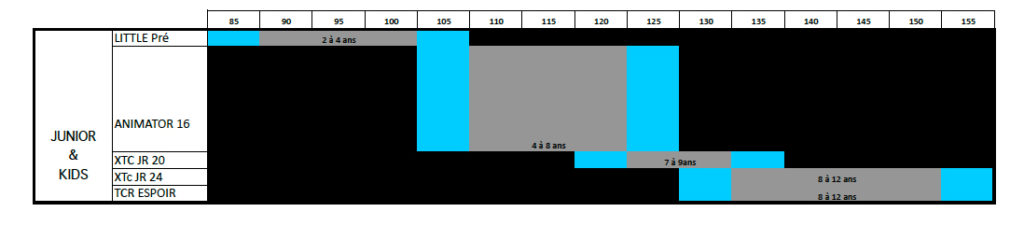
Children's bicycle sizes are generally based on wheel size. Please read the children's bike size guide.
If you're unsure which bike size is right for you, our team of cycling specialists is here to help. Call us on 05 62 39 44 61 or email evolution2.saintlary@gmail.com and we'll be happy to assist you.
What frame size do I need if I'm between two sizes?
Sometimes, the bicycle size chart recommends two different bicycle frame size options. Which size should we choose?
Most bicycles are not limited by frame height because the saddle is easy to adjust.
The key measurement is the top tube length. This dimension is related to your torso length as well as your arm length. Torso length is the measurement from your hips to your shoulders.
If your trunk length is longer than average, the larger of the two sizes recommended in the size chart will be ideal.
If, on the other hand, you have a shorter than average trunk height, then the smaller of the two recommended sizes will probably be best for you.
Once you have your bike, you can make some adjustments to fine-tune the fit: Adjusting the saddle's forward position, the stem's dimensions, for example.
Can I use the typical bike size chart for women's specific bikes?
Yes, women's specific bikes generally have different bike frame sizes than unisex bikes, but they are in the same size chart.
Women tend to have shorter upper bodies than men, so women's specific frames have a different shape.
The top tubes are slightly shorter than unisex bikes, which reduces the reach, so female riders won't feel so stretched out.
Women who are between sizes on a unisex bike can choose the smaller of the two recommended sizes.



- Published in Cycling equipment, BIKE, Road bike, Mountain biking
SAINT LARY BY MOUNTAIN BIKE
Mountain biking in Saint Lary in the Pyrenees: What are the routes for practicing enduro mountain biking, cross country, DH around St Lary?
The mountain biking area in the Aure Valley around Saint Lary includes 2 enduro mountain biking trails and 1 bike park. Teams of passionate mountain bikers and trail shapers have crafted incredible singletracks!
Saint Lary Aure Valley
In the Aure valley around Saint Lary, the old singletrack shepherd's path reigns supreme and is available in its natural or transformed version!
The Aure Valley has long been a place where passionate trail builders work for the greater good of mountain biking. While the first trails were certainly opened unofficially, the activity is now well-organized, the mountain bike trails are well-marked…but the Aure Valley mountain biking area retains a strong identity: that created by mountain bike enthusiasts who shape and ride.

Make no mistake, the valley hasn't been transformed into an artificial bike park. The most beautiful singletracks remain natural, and the developed trails remain perfectly discreet, integrated into the mountain.
Mountain biking in Saint Lary: the different riding areas. A map shows all the trails. (association mtb trails 65).

In the valley, we have several mountain biking areas with different orientations and locations. Everyone can have fun and enjoy their stay by trying out the different mountain biking disciplines: XC, enduro, DH, Ebike…
Fabian bike center, the Ens descents, the "mtb trails 65" website…
FABIAN BIKE CENTER
6 trails: 2 green trails for very young riders, one blue trail, one red trail, and one black trail. All trails are listed and detailed on the map of the association «mtb trails 65».
We organize drop-offs at the top of the routes on this site. Take advantage of the shuttle and enduro mountain bikes from the "Evo2 Store" to discover this beautiful site.
We recommend starting your enduro mountain biking adventures around Saint Lary at the Fabian bike center. The "Goupil" trail is perfect for a first introduction to downhill mountain biking. It's smooth, the berms are well-shaped, and the whoops are accessible…
Here is a video of the "Goupil" trail at the Fabian Bike Center
The other trails are in the same vein, but with steeper gradients and more pronounced bumps. The terrain is generally smooth and very well-shaped.
The "Fabian bike center" site is extremely well marked. It's safe for beginners because the difficulty level of the mountain bike trails increases gradually. It's reassuring and similar in spirit to a bike park in a resort, but in a natural setting amidst a beautiful fir forest.
Warning: The lift connection between the slopes is very steep. With a full-suspension electric mountain bike You can do all the trails in half a day.
ENS
Starting from the village of Ens Four enduro singletrack trails wind through ferns and forest. Fun and well-shaped, there's one red trail and two rather technical and steep black trails. These trails end just above the village of Saint Lary.
The classic trail is somewhat in the style of the Fabian bike center. The track is easy. The other two mountain bike trails are completely different. They are much more natural, narrower, more technical with steep sections and some shale patches requiring a good level of riding skill.
We particularly love the "Allbro" trail, which is in an incredible setting. Steep slopes alternate with gentler sections winding through a forest well-preserved from logging.
MTB TRAILS 65
How was the mountain biking website "MTB TRAILS 65" created?

The mountain bike site was created in the spring of 2015. Mountain biking enthusiasts recreated and reopened old mountain trails, adapting them for mountain biking. Hundreds of hours of work by volunteers, using picks and shovels, have resulted in singletrack trails ideal for enduro mountain biking. The site stands out because it beautifully blends old tracks once used by herds with a modern approach to mountain biking.

http://www.zapiks.fr/mtb-trails-65-site-vtt-endur.html

One and a half years of administrative procedures, 21 meetings before creation…What are the objectives of this site?
- To propose a marked mountain biking site in the Hautes Pyrénées with routes classified by difficulty levels, predominantly "All Mountain / Enduro"«
- Select natural routes adapted to the current requirements of practitioners that do not require ski lifts.
- Participate in the maintenance of the existing network of paths. (The old mountain paths are part of the cultural heritage of the valley and are unfortunately disappearing).
- Creation of new routes adapted for mountain biking
The enduro mountain biking site has an agreement with the town halls of Ancizan, Cadeac, Barrancoueu.
The site is recognised by the Communities of Communes, the FFC, the Departmental Council, the MBF, the ONF.
The Mountain Bikers Foundation (MBF) supports the website "MTB TRAILS 65"«
http://mbf-france.fr/brigadesvertes/trail-work-day-2015-2/
All the work is done by volunteers.

The group of volunteers who run the mountain biking site are as much involved in mountain biking as they are consumers! On a more informal level, a core group (a small handful) of the association meets very often.
The site map is sold for €10. This helps to partially fund the maintenance of the trail markings and the professional equipment used.
The association is open to everyone; a new office has just been opened comprising people from different backgrounds. http://mtb-trails-65.com/
This volunteer work is of high quality: It is recognized by participants, regular mountain bikers and competitors.
Before the creation of the official website, the trails were already frequented by enduro riders. The first enduro event in the Pyrenees was the Aure Enduro, organized from Ancizan. (2008)
The 2008 edition provided the opportunity to map out the current trail No. 5 "Hourquette". It has been constantly improved ever since.
Reviews from regular users

- Forum of the "VTT64" association« http://www.vtt64.com/forum/
- There are many positive comments on the web
The Saint Lary Bike Park
This downhill mountain biking site is located in the St Lary ski resort. The 9 downhill mountain biking trails of Saint Lary are situated between 1600 and over 2200m altitude.

The mountain bike trails in the Bike Park are classified like the ski slopes (by color). From the village, the cable car (Pic de Lumière) provides access to the bike park.
ENDURO D'AURE: The event takes you through the best spots in the Aure valley
- Published in BIKE, Mountain biking