
SKI
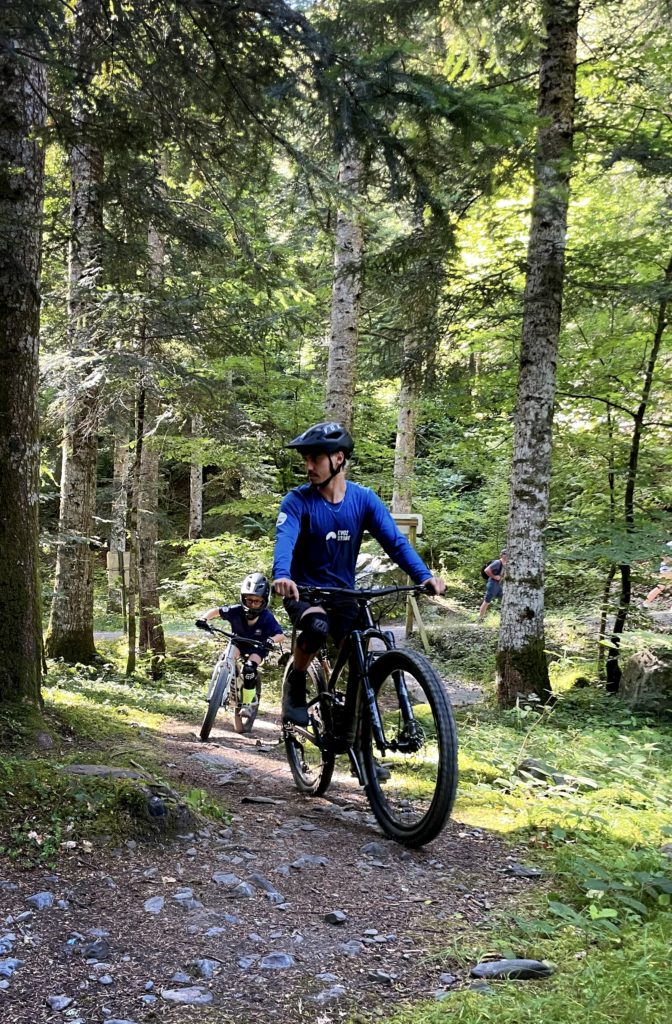
Saint-Lary Bike Park (Pyrenees): the high-intensity mountain biking experience
Discover downhill mountain biking paradise in the Pyrenees
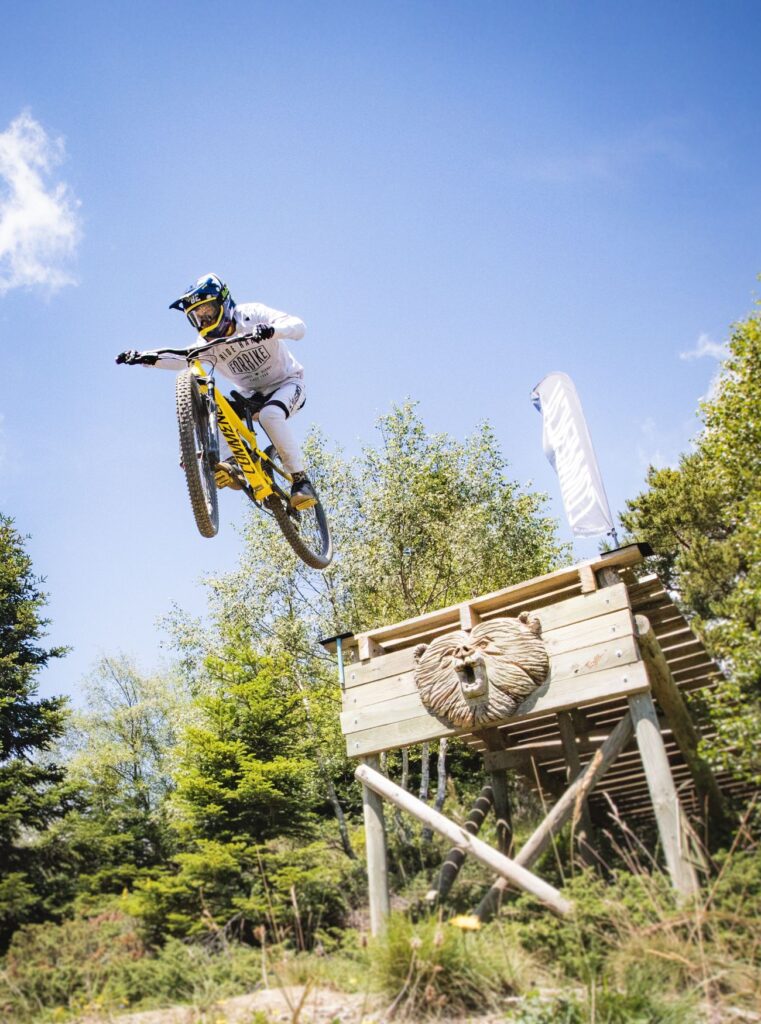
The village of Saint-Lary-Soulan, Nestled in the Aure Valley, it is known for its ski slopes in winter. But in summer, the resort transforms into a veritable downhill and enduro mountain biking spot : THE Saint-Lary Bike Park. Accessible, varied and fun, it is a must-try for riders of all levels.
A unique Bike Park in the Pyrenees
Located between altitudes of 1,700 m and 2,215 m, The Bike Park is served by the Bouleaux chairlift, specially equipped to transport bicycles. It features around ten marked trails, from green to black, suitable for both beginners and experts.
👉 Official information: Saint-Lary Tourism – Bike Park
👉 Schedules and packages: Altiservice Bike Park
The slopes: fun for all levels
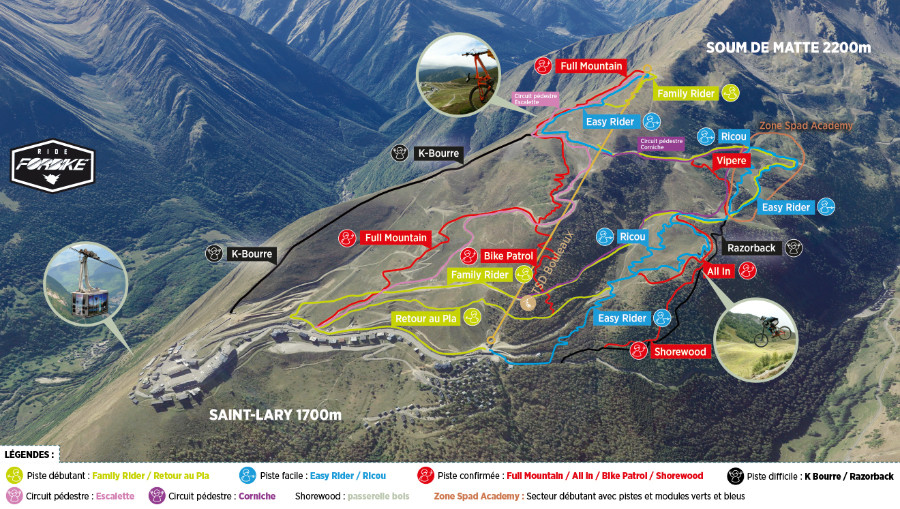
- Green (easy) : Family Rider for a gentle warm-up.
- Blue (intermediate) : Easy Rider, accessible and user-friendly.
- Red (confirmed) : Full Mountain And Woodstock, fast tracks with jumps and banked turns.
- Black (expert) : K Bourre And Razorback, reserved for experienced riders.
- Speciality : Shorewood, unique 100 % wood track in the Pyrenees.
📌 Trail map and details: Trailforks – Saint-Lary Bike Park
On-site services and support
The Bike Park is secured and maintained by the Bike Patrols, who ensure the quality of the trails and the safety of the riders.
For equipment and supervision, specialists such as Evolution 2 Saint-Lary offer Mountain bike rental, instruction and downhill courses.
👉 More info: Evolution 2 Mountain Bike Specialist
When to come and how much does it cost?
The Bike Park is usually open from the end of June to the end of August, with day or season passes.
- 1-day pass with ski lifts
- Summer pass for regular users
- Reduced rates for young people and families
👉 Updated prices: Altiservice Bike Park Saint-Lary
Reviews and reputation
The Saint-Lary Bike Park has received very positive feedback from the mountain biking community.
- On Trailforks, Riders appreciate the balance between "flow" trails and technical sections.
- The guide Ultimate France Saint-Lary ranks among the best bike parks in the Pyrenees. 👉 Ultimate France – Saint-Lary
- TripAdvisor visitors highlight the friendly atmosphere and the quality of the slopes. 👉 TripAdvisor Bike Park Saint-Lary
Practical tips for a successful day
- Choose a track that suits your skill level. (Don't skip any steps).
- Equip yourself properly : full-face helmet, gloves, knee pads, back protector.
- Anticipate the end of the day : last chairlift departure at 3:50pm.
- Check the weather : in the mountains, it changes quickly.
- Enjoy the events Contests, enduros and timed downhill races are organized every summer.
Conclusion
THE Saint-Lary Bike Park is a must for mountain biking enthusiasts. With its varied trails, friendly atmosphere and breathtaking Pyrenean scenery, it appeals to both families and experienced riders.
So, ready to test your suspension this summer in the Pyrenees? 🚵♂️🔥
- Published in Ski school
Saint-Lary (Pyrenees): the perfect destination for family holidays and sports lovers
🏔️ Discover Saint-Lary, the jewel of the Pyrenees
In the heart of the Aure Valley, Saint-Lary is one of the most popular resorts in the Pyrenees. Both authentic and modern, it attracts families looking for relaxation as well as sports enthusiasts in search of adventure.
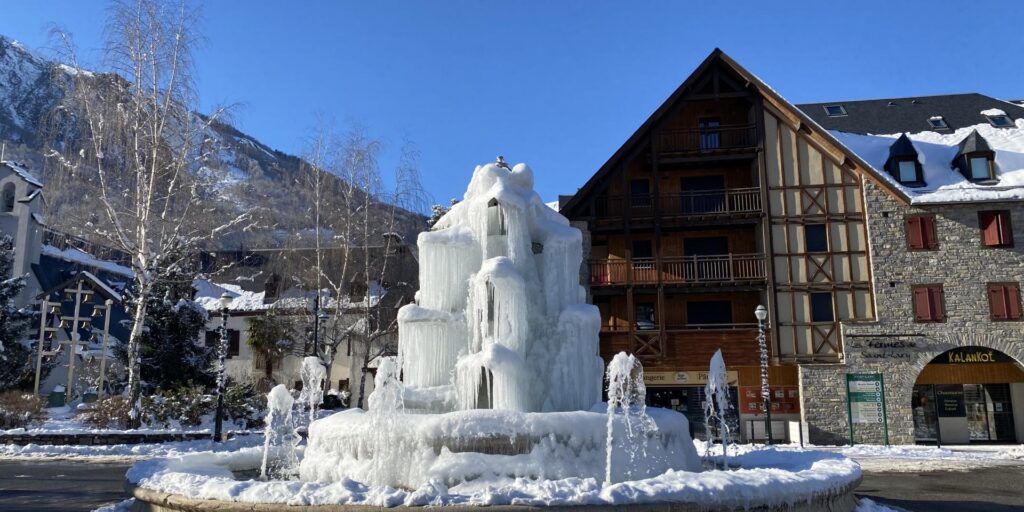
Easily accessible from Toulouse and close to Spain, Saint-Lary combines the charm of an authentic mountain village with the infrastructure of a major tourist destination.
🎿 Winter in Saint-Lary: skiing for everyone
With its 250 hectares of slopes, Saint-Lary is a paradise for skiers:
- Beginners and advanced skiers will find runs suited to their level.
- Group and private ski lessons with certified instructors (👉 book your ski lesson) guarantee safe and fast progress.
- Children can discover skiing with the « Yeti Academy« and fun areas.
- Ski enthusiasts can enjoy freeride and ski touring in breathtaking landscapes.
👉 Whether you are planning a family trip or an adrenaline-filled holiday, Saint-Lary has it all.
🚵 Summer in Saint-Lary: cycling, MTB and hiking
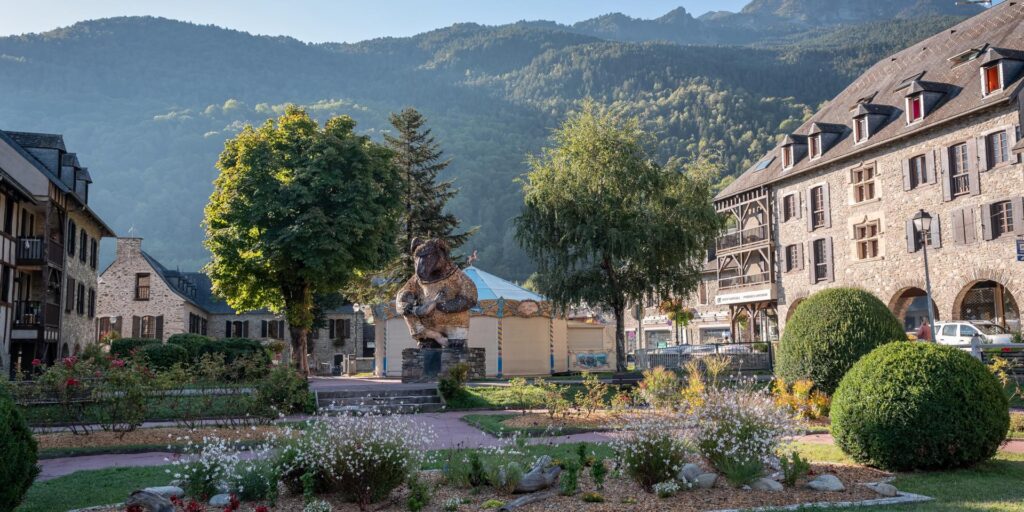
When the snow melts, Saint-Lary turns into a playground for outdoor lovers:
- Bike Park and MTB trails (enduro and downhill).
- Legendary Tour de France climbs: Aspin, Peyresourde, Tourmalet.
- Family-friendly hikes and stunning mountain lakes.
- Original outdoor activities: e-scooters, via ferrata, canyoning, rafting.
👉 A varied playground for both families and expert athletes.
👨👩👧 Family holidays in Saint-Lary
Saint-Lary is designed for families:
- Warm and cozy accommodation (chalets, hotels, apartments).
- Activities for all ages: skiing, sledging, walks, swimming pool, Sensoria spa center.
- A compact village, easy and safe to get around on foot.
👉 The perfect mix of simplicity, comfort and authenticity.
🍷 The «after»: relax and enjoy
In Saint-Lary, holidays don't end when you leave the slopes:
- Wellness at Sensoria Rio (heated pools, spa, hammam).
- Local gastronomy: garbure stew, mountain cheeses, charcuterie and wines.
- Village life: bars, restaurants, après-ski concerts and seasonal events.
- Shopping for crafts and local souvenirs.
👉 The après-ski and après-ride are part of the unique Saint-Lary experience.
✨ Why choose Saint-Lary?
- Year authentic Pyrenean village, alive all year round.
- A complete sports destination: skiing, cycling, MTB, hiking and outdoor adventures.
- A family-friendly resort with adapted facilities.
- Tea Pyrenean way of life: sport, gastronomy and conviviality.
📅 Plan your trip to Saint-Lary
Whether you come for skiing, cycling, or simply to enjoy the mountains with your family, Saint-Lary is the perfect destination in the Pyrenees.
👉 Discover ski lessons and outdoor activities with Evolution 2 Saint-Lary
❓ FAQ — Planning your trip to Saint-Lary (Pyrenees)
How to get to Saint-Lary?
Saint-Lary is accessible by car via the A64 motorway, by bus from Lannemezan/Tarbes, and by plane via Toulouse, Tarbes-Lourdes or Pau. The village is compact and easy to explore on foot.
When is the best time to ski in Saint-Lary?
The ski season usually runs from December to April (depending on snow conditions). School holidays are lively and festive, while off-peak weeks are quieter and perfect for learning.
Where can I book ski lessons for children and adults?
At Evolution 2 Saint-Lary: group lessons, private coaching and ski camps for all levels (with the Yeti Academy (for kids). 👉 Book a ski lesson
Can I rent equipment on site?
Yes: skis, snowboards, helmets, protective gear in winter, and Mountain bikes / e-bikes / road bikes in summer. 👉 See our rentals
Is the Bike Park suitable for families?
Yes, there are green and blue trails for beginners, as well as enduro and downhill tracks for experienced riders. Check seasonal openings in advance.
What to do after skiing or hiking (“the after”)?
Relax at Sensoria spa, enjoy local cuisine (garbure stew, cheese, charcuterie, wines), have fun at bars or concerts, and discover artisan shops.
What can we do in bad weather?
Indoor activities include spa and swimming pool, visiting museums, shopping, or indoor training/coaching sessions when ski lifts are closed. 👉 Our activities
Is Saint-Lary family-friendly for young children?
Yes: snow gardens, fun areas, easy slopes, family accommodation and a safe, walkable village.
Are there legendary cycling routes around Saint-Lary?
Yes: Aspin, Peyresourde, Tourmalet are nearby (depending on weather and season). Always check road conditions before heading out.
Where can I find the meeting points for ski lessons and activities?
See the dedicated Evolution 2 meeting points page with updated maps, schedules and practical tips. 👉 See meeting points
- Published in Ski school
Saint-Lary (Pyrenees): an ideal resort for your family and sports holiday
🏔️ Discover Saint-Lary, a jewel of the Pyrenees
In the heart of the Aure Valley, Saint-Lary is one of the most renowned resorts in the Pyrenees. Both authentic and modern, it appeals to everyone. families that the athletes in search of adventure.
Easily accessible from Toulouse and close to Spain, Saint-Lary combines the charm of a lively Pyrenean village and the infrastructure of a large mountain resort.
🎿 Winter in Saint-Lary: skiing for everyone
With its 250 hectares of trails, Saint-Lary is an ideal playground:
- Beginners and experienced players alike will find trails suited to their level.
- THE group ski lessons And privates supervised by professional instructors (👉 book your ski lesson) allow you to progress with confidence.
- Children discover the joys of skating with the "« Yeti Academy »and the play areas.
- Enthusiasts take advantage of the freeride or free ski touring in magnificent landscapes.
👉 Whether you are looking for a family holiday or thrills, winter in Saint-Lary caters to all desires.
🚵 Summer in Saint-Lary: cycling, mountain biking and hiking
When the snow melts, Saint-Lary transforms into a paradise for sports and nature lovers:
- Bike Park and tracks Enduro/downhill mountain biking.
- Mythical mountain passes of the Tour de France: Aspin, Peyresourde, Tourmalet.
- Family hikes and spectacular high-altitude lakes.
- Unique outdoor activities: off-road scooters, via ferrata, canyoning, rafting.
👉 A varied playground for families as well as experienced athletes.
👨👩👧 Family vacation in Saint-Lary
Saint-Lary is designed for families:
- Cozy accommodations (chalets, hotels, apartments).
- Activities for all ages: skiing, sledding, walks, swimming pool, Sensoria water park.
- A a village on a human scale where everything is within walking distance.
👉 Guaranteed simple, practical and friendly stay.
🍷 The after-party: the other side of Saint-Lary
In Saint-Lary, the holidays don't stop on the slopes or the trails:
- Well-being in the center Sensoria Rio with heated pools, spa, hammam.
- Gastronomy with garbure (a traditional Gascon soup), cheeses, cured meats and local wines.
- Village atmosphere : bars, concerts, après-ski entertainment.
- Shopping for handcrafted products and Pyrenean souvenirs.
👉 The’après-ski and après-ride are part of the unique Saint-Lary experience.
✨ Why choose Saint-Lary?
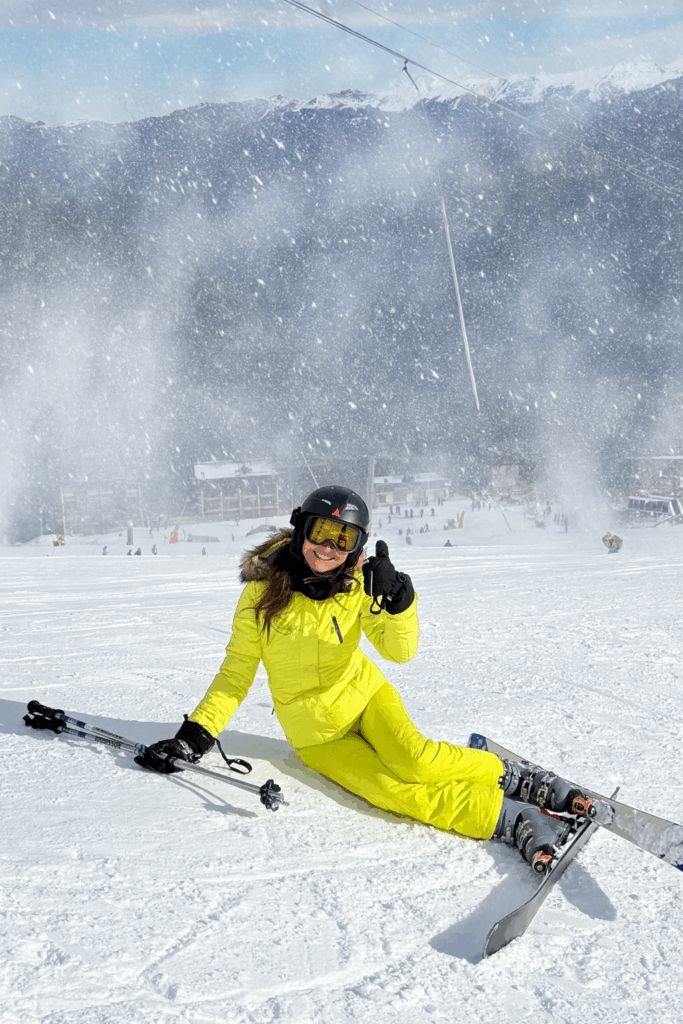
- A authentic village and living all year round.
- A complete sports offer : skiing, cycling, mountain biking, hiking, outdoor activities.
- A family destination secure and accessible.
- L'’Pyrenean way of life : sport, conviviality and gastronomy.
📅 Plan your stay in Saint-Lary
Whether you come for skiing, cycling, or simply to enjoy the mountains with your family, Saint-Lary is the ideal destination in the Pyrenees.
👉 Discover our ski lessons and outdoor activities with Evolution 2 Saint-Lary
❓ FAQ — Preparing your stay in Saint-Lary (Pyrenees)
How to get to Saint-Lary?
Saint-Lary is accessible by car from the A64, by bus from Lannemezan/Tarbes, and by plane via Toulouse, Tarbes-Lourdes, or Pau. The village is compact; everything is easily accessible on foot.
What is the best time of year to ski?
Of December to April (depending on snow conditions). School holidays are more active; outside of holidays, it's calmer and conducive to progress.
Where to book ski lessons for children and adults?
At the house of Evolution 2 Saint-Lary Group lessons, private lessons, and workshops adapted to each level (Yeti Academy for children). 👉 Book a course
Is it possible to rent equipment on site?
Yes: skis, snowboards, helmets, protective gear, as well as Mountain bikes / bicycles in the warmer months. 👉 See our ski rentals And bike rentals in Saint-Lary.
Are the Bike Park and mountain bike trails suitable for families?
Yes, some leads green/blue There are resources available for beginners, and some routes are available. enduro/downhill For the more experienced. Check the seasonal opening dates.
What to do after skiing or hiking (“the after”)?
Spa & baths at Sensoria, village bars and restaurants, tasting of local specialties (garbure, cheeses, cured meats), concerts and entertainment depending on the season.
Are there any activities available in bad weather?
Spa, swimming pool, local museums, workshops/shops, village walks, private technical lessons (skiing/video coaching) when the lifts are closed. 👉Our activities
Is Saint-Lary suitable for families with young children?
Yes: snow gardens, play areas, easy routes, accommodation close to amenities, village on a human scale.
Will road cyclists find mythical mountain passes?
Yes : Aspin, Peyresourde, Tourmalet (depending on conditions and time of year). Plan your outing and check the weather/any potential closures.
Where can I find information about meeting points for courses/activities?
Visit the page Evolution 2 Meeting Points with maps and schedules. 👉 See the meeting points
- Published in Ski school
Our refurbished bikes: the smart and responsible choice
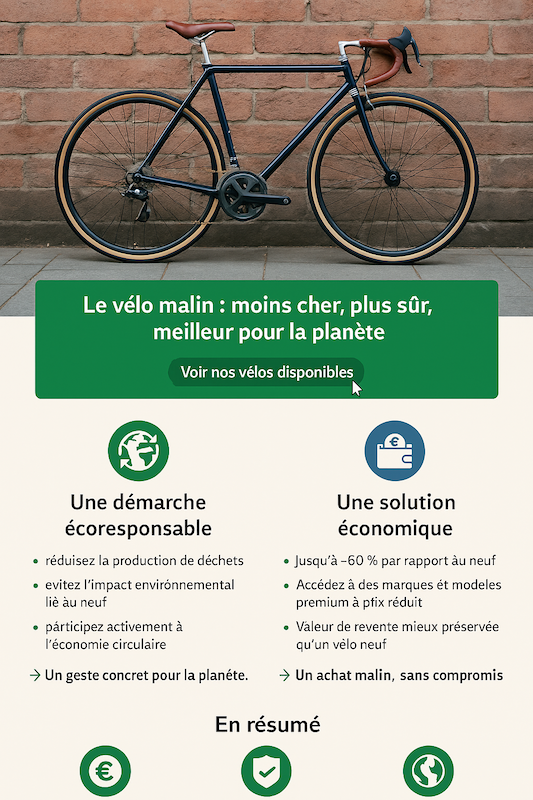
Buying a refurbished bike is much more than just a smart purchase: it's a sustainable approach, a economical solution, and a security guarantee. At our company, each bike goes through a rigorous inspection and refurbishment process to offer you a riding experience close to new, but at a much more accessible price.
🌍 An eco-responsible approach
Every refurbished bike is a bike that escapes the scrap heap and finds a new life.
By choosing refurbished, you:
- reduce waste production,
- Avoid the environmental impact associated with manufacturing a new bicycle.,
- actively participate in the circular economy.
👉 It's a concrete gesture for the planet, without compromising your enjoyment of cycling.
💶 A smart investment
Our refurbished bikes are available 30 to 60 % cheaper than equivalent new models.
This allows you to enjoy quality bikes, often from major brands, at a much more affordable price.
In addition, a refurbished bicycle loses less value it has a higher resale value than a new bike, which also makes it a smart long-term choice.
👉 You spend less, but you gain in peace of mind and performance.
🔧 Quality, safety and reliability
Unlike a used bicycle bought from a private individual, a refurbished bicycle is:
- completely disassembled and inspected by our qualified technicians,
- equipped with new parts replaced if necessary (brakes, tires, chain, transmission…),
- tested and adjusted to guarantee comfort and performance,
- delivered with a guarantee, proof of our commitment to quality.
👉 Result: you leave with a bike reliable, safe and ready to ride.
🤝 A responsible and local choice
By buying a refurbished bike, you are also supporting:
- of the local workshops and passionate technicians,
- an approach of’circular economy which values repair rather than disposability,
- more conscious and committed consumption.
Every bike has its story, and thanks to you, it can write a new one.
✅ In summary
A refurbished bicycle is:
- Cheaper than a new one
- Safer than a mere opportunity
- Better for the planet
👉 Make the smart and responsible choice: adopt a refurbished bike, and enjoy the road differently.
Specialist bicycle shop
The refurbished bikes from the "Evo2 Store" can be seen on the online sales site.
All these bikes can be delivered to your home.
You can also test these bikes around Saint-Lary in an exceptional natural setting.
- Published in Ski school, Cycling equipment
Why maintain your skis (or your board)?
Publication date: March 18, 2025 – by Stéphane
You might be wondering: "Why waste time maintaining my skis or snowboard?" In reality, it's one of the best investments you can make to improve your enjoyment of skiing, make your practice safer, and extend the life of your equipment.

1. Energy savings and increased safety
Properly sharpened edges ensure optimal grip, especially on hard or icy snow. As a result, you expend less effort maintaining your turn, you have better control, and the risk of an uncontrolled slide is reduced.
2. Improved glide & smoother turns
A well-maintained base (waxed, smoothed, repaired) glides better. Turns are sharper, the transition is more "natural", and the pleasure of gliding goes up a level.
🛠 Diagnostic: what to check after each outing?
Here are some key points to inspect after a day of skiing or riding:
| Element | What you need to look at | Why this is important |
|---|---|---|
| Blunt squares | A feeling of slipping in the corners, lack of grip | A dull edge no longer bites into the snow, especially on hard snow. It must be sharpened by a professional. |
| Scratches/nicks on the sole | Small striations, traces of stones, grey areas | Even a light scratch reduces glide. If the base is damaged down to the core or the edge, it requires serious repair. |
| "Dry" sole / wax loss | Greyish appearance, fluffy texture, dull, shine-free areas | This indicates a lack of wax. A fresh layer of wax nourishes the base, protects against drying out, and restores glide. |
«"Wax wears off quickly, especially on dry snow. It is recommended to re-wax every 2 to 4 days of use."»
How often and when should maintenance be performed?
Here are some guidelines to prevent your equipment from deteriorating:
- Before the season : complete maintenance (repairs, sharpening, waxing) to leave with top-quality skis.
- During the season : regular checks, waxing as soon as the base appears dry, and intermediate sharpening if you feel a loss of grip.
- After the season / before storage : a conservation wax (thicker) and a general check to prevent edge corrosion during the summer.
What should you do yourself vs. what should you leave to the professionals?
| DIY | To be entrusted to a specialist workshop |
|---|---|
| Clean the sole, brush, scrape off any old residue. | Edge sharpening, large-scale repairs (corridor damage, deep scratches) |
| Apply standard wax | High-performance waxing (infrared, overmolding, professional wax) |
| Visually inspect the fixings | Safety adjustment / DIN rail check of fasteners |
📌 Warning: Improper home sharpening can increase unintended angles or damage the edge. It's best to rely on a professional for technical work.
“Before/After” Summary”
Before the interview
- Rusty/blunt squares
- Visible scratches on the sole
- Dull, unstructured sole
After interview
- Sharpened edges
- Smooth, uniform sole
- Preserved structure, optimized glide and grip
In conclusion
Maintaining your skis or snowboard isn't a chore — it's a way to:
- optimize your performance (glide + precision)
- increase your security
- protect your equipment in the long term
If a complete overhaul (repairs + sharpening + waxing) seems intimidating, start with the simple steps: cleaning, checking, a little waxing… and call on a workshop for the more technical operations.

- The edges are rusty and dull.
- The sole is torn or scratched
- The sole no longer has any structure
After

- The edges are perfectly sharpened.
- The sole is flat and flawless
- The sole is structured
- Published in Ski school
The ideal checklist for your ski lessons in Saint-Lary

Published on February 9, 2024 – by Stéphane
Your ski holiday is approaching, and to ensure everything goes smoothly (and without forgetting anything), here is the complete checklist to prepare your ski lessons or those of your children in Saint-Lary.
Before departure: the essentials
- Print the course booking confirmation
- Note down the school's contact information. Evolution 2 Saint-Lary and the specialty store Evo2 Store (equipment collection or rental)
- Identify the meeting point (location, time)
- Check all your equipment and clothing
Clothing & Apparel
- Thermal underwear & ski socks
- Fleece jacket or warm (breathable) sweater
- Ski pants + ski jacket (waterproof, windproof)
- Hat/headband + scarf/neck warmer
- Ski gloves (waterproof, well-insulated) + "spare" gloves for breaks
- For children: a snowsuit (one garment only) is recommended to prevent snow from getting in.
- Balaclava / under-helmet (useful for protecting ears / forehead)
Ski equipment
- Ski boots, skis & poles (for beginners, poles are not essential at the very beginning)
- Helmet (recommended for everyone, mandatory for children in school)
- Ski rack (Velcro type) to facilitate the transport of skis
- Ski goggles and/or sunglasses (snow strongly reflects UV rays)
That same morning
- Have a good, complete breakfast
- Apply sunscreen (face, exposed areas) + lip balm
- Make sure you have your plan (if applicable)
- Get the piste or resort map
- Be punctual / present at the meeting point
Small, useful accessories to put in your pocket or bag
- Snack or cereal bar
- Sunscreen + spare lip balm
- Handkerchiefs
- Optional extras: spare gloves/mittens, small bandages, energy snacks
Summary version with checkboxes
🗹 Booking confirmation
🗹 Contact details & meeting place
🗹 Thermal underwear / socks
🗹 Fleece jacket / sweater
🗹 Waterproof coat + trousers
🗹 Hat / scarf / balaclava
🗹 Ski gloves + spare
🗹 Shoes, skis, poles
🗹 Helmet
🗹 Mask / glasses
🗹 Sunscreen + balm
🗹 Breakfast
🗹 Ski pass / trail map
🗹 Snack / tissues
Why this checklist?
- To avoid last-minute stress
- So that your children (or you) are not embarrassed by oversights
- To maximize comfort and safety during the course
- To ensure your first day on the slopes is a pleasant experience
- Published in Ski school, SKI
How to choose your ski boots?
The characteristics of ski boots
Men's and women's shoes
Men's and women's ski boots have an ergonomic design adapted to morphological differences, particularly at the calf level, which is inserted lower in women.
Ski boots for women therefore have a collar (upper part of the shoe) lower, more flared and with a cutout at the back to fit the shape of the calf.
Because blood circulation and venous return are more sensitive in women, slippers are generally warmer.

The flex
Another important factor to consider when choosing ski boots: the flex. It's the‘'shoe stiffness index', between 60 and 150. The choice of flex for a ski boot is related to the skier's level and morphology. The higher the skier's skill level, the more rigidity they will need to transmit their weight to the skis. At the same skiing level, a larger skier will also need a higher flex rating.
- Beginner skier Flexion range: between 60 and 90 for men, between 60 and 70 for women
- Intermediate skier Flexion between 90 and 110 degrees for men, 70 to 90 degrees for women
- Expert skier Flexibility of 110 and above for men, 90 and above for women
- The stiffest shoes are reserved for top-level competitors and have a flex of 140 to 150.
The flex index is not standardized. Therefore, there are differences in stiffness between brands with the same flex.
You can adjust the stiffness of your shoe by playing with the tightness of the collar: loosen the top hooks a little if you want to gain flexibility.
How to choose the right size ski boot in mondopoint?
The Mondopoint size, often shortened to "Mondo," is an international unit of measurement used primarily for ski boots. It represents foot length in centimeters. For example, a Mondo size of 27.5 corresponds to a foot measuring 27.5 cm in length. This measurement method offers greater accuracy and overall uniformity compared to traditional systems that vary from country to country (such as US, UK, or EU shoe sizes). By using the Mondo size, skiers and ski boot manufacturers can ensure a proper fit, thus providing better performance and greater comfort, regardless of regional variations in shoe sizes.
What size should I choose in cm for my ski boots?
How do I find my Mondopoint size?
To overcome the uncertainty of UK, US and FR shoe sizes, ski boots use a size called Mondo Point which corresponds to the size of the foot in centimeters.
What is shoe volume?
The boot's volume refers to the internal space of a ski boot, encompassing its width, height, and depth, to accommodate the foot. It is essential for determining a boot's comfort, as two boots of the same size can have different boot volumes.
What length of ski boot should I choose?
There length of your ski boot must first and foremost be adapted to your skill level :
To do this, let's consider two types of skiers:
- THE expert skiers Since they generally prioritize precision over comfort, they will choose a boot that corresponds exactly to the size measured with a foot measuring device. For example, with a foot measuring 27 cm, an expert skier will choose a Mondo Point 27 boot.
- THE recreational skiers Prioritizing comfort without sacrificing precision, they can allow themselves half a centimeter more than their shoe size. For example, a recreational skier with a 27 cm foot would choose a Mondo Point 27.5 boot.
What width of ski boot should I choose?
There width of your ski boot It must also be adapted to your body shape.
Generally, each brand offers several shoe ranges with varying fit volumes. Some models will therefore be specifically designed for... narrow feet, others to medium feet and others still at wide feet. Everyone will thus find their happiness and true lasting comfort.
THE shoe volume (Or fitThis corresponds to the width at the metatarsals. The width of a ski boot is always expressed for a reference size of 26.5, even if you choose a size smaller or larger. The volume index primarily serves as a guide for comparing models and makes it easy to find the right width for your foot shape.
However, since the shoe volume is proportional to each shoe size, it varies from one size to another. If the shoe volume is 100 mm for a pair that is size 26.5 in Mondo Point, the shoe volume will be less than 100 mm for a size smaller than 26.5 and it will be greater than 100 mm for a size larger than 26.5.
- If you have narrow feet, we advise you to favour boots with a last of 97, 98 or even 100 mm.
- If you have average feet, your preferred choice will be ski boots with a 100mm or 102mm last.
- And if you have wide feet, definitely go for a shell with a thickness greater than 102 mm to find the comfort needed to spend long hours on the slopes.
Of course, these boot volumes are given as a guideline. If you like to ski hard all day long on red and black runs, you can opt for a slightly narrower fit for greater precision. Conversely, if comfort is your priority, choose the higher end of the indicated ranges. In addition to all this length and width information, don't hesitate to refer to any specific recommendations for each boot model.
- Published in Ski equipment, SKI
All-mountain skiing: Construction, length, flex, turn radius, rocker, camber….

Gold in the versatility category.
An all-mountain ski is the eternal runner-up among skis: it's the second best in powder after wider off-piste skis, the second best on piste after neater, narrower piste skis, and a solid silver medalist in touring after pure, lighter touring skis. Never the worst, never the best. A reliable ski category. If someone calls your all-mountain ski average and boring, you can tell them it actually wins gold in the versatility category.
HOW IS AN ALL-MOUNTAIN SKI CONSTRUCTED AND WHAT MATERIALS ARE USED?
Ski construction varies considerably depending on the model and manufacturer. Generally, however, this type of ski consists of a core, usually made of wood. The ski acquires different properties depending on the type of wood used, and factors such as weight, elasticity, and durability are taken into account and combined. Skis are sometimes reinforced with metal and various fibrous materials like fiberglass. A ski with metal reinforcement is generally stiffer and more stable, while a ski without metal is lighter and more playful. All-mountain skis are constructed with and without metal depending on the desired characteristics.
WHAT IS THE DIFFERENCE BETWEEN ALL MOUNTAIN SKIS FOR WOMEN AND MEN?
Women are generally smaller than men and therefore usually weigh less. Women's skis are thus generally a bit softer than men's skis and are available in shorter lengths.
On women's skis, the recommended mounting point, the location where the binding should be mounted, is often positioned further forward, making it easier to initiate turns without requiring as much force. The skier ends up positioned slightly further forward on the ski.
Some brands choose not to differentiate between men's and women's skis, and others only have different graphics on an otherwise identical ski; these skis are often described as unisex.

HOW LENGTH SHOULD MY ALL-MOUNTAIN SKIS BE?
Choosing the right ski length is difficult, and many factors need to be considered, such as weight, experience, and the type of skiing you prefer. A general rule is to start with your own height, then think about how and where you ski.
If you're a good skier who skis fast on steep slopes, you can benefit from a few extra centimeters of length. If you prefer skiing off-piste or on groomed terrain, you can also benefit from a pair of skis that are longer than you are. This will give you a length roughly equivalent to your body length plus 5 to 15 cm.
If you haven't skied much, you might benefit from a slightly shorter pair of skis. They'll be a bit more maneuverable and easier to turn. Even if you ski a lot but are looking for fast turns on groomed runs (like slalom turns), you'll still benefit from choosing shorter skis. If we're still talking about all-mountain skis, you're probably already fairly close to your body length, even if you're looking for fast skiing.
Of course, there's also room for your personal preferences!
WHAT TURNING RADIUS SHOULD I HAVE?
The turning radius is a favorite topic for many ski buyers. It's a clear and easy-to-compare figure for comparing models. Simply put, the radius is given in meters, where a larger radius means a longer turn and a smaller radius means a shorter turn. For example, a 12-meter radius produces a very tight turn, suitable for those who want to turn very quickly, while a 27-meter radius, for instance, makes the ski turn slowly in wide turns, which is better for those who want to go fast. .
If you have a ski with a tight turning radius, you might feel like you're being thrown out of the turn and that the ski is turning too fast when it gets stiff and wants to turn on its own, whereas a ski with a long turning radius can feel slow and boring.
The tricky thing about turning radius is that other ski properties, such as flex, binding mounting, and so on, play a significant role in the experience you have when turning. A ski with a theoretical radius of 20 meters can therefore "turn more" in practice than a ski with a radius of 18 meters. In other words, it's always best to test the skis before buying them, but if you don't have the opportunity, the radius number is certainly a starting point, but at the same time, don't rely on it blindly.
ROCKER AND CAMBER, WHAT'S THE DIFFERENCE?
Camber means the ski is bent downwards (just like a pair of cross-country skis) and full camber/reverse camber means the ski is bent upwards (like a pair of water skis).

Rocker skis became popular a few years ago; before that, almost all skis had traditional camber. A ski with traditional camber is generally more stable and performs better when fast and hard, while a ski with rocker is often considered easy to turn and playful without the ski digging in and getting stuck in the snow, and therefore it is good on groomed runs and in the trees and similar terrain.
All-mountain skis typically feature a combination of traditional camber underfoot and reverse camber/rocker in the tip and tail, resulting in a versatile ski, just as all-mountain skis should be. We can call this a "mustache rocker" because it resembles a well-groomed mustache.
WHAT IS FLEX AND WHAT DIFFERENCE DOES IT REALLY MAKE?
Flex simply refers to the stiffness of the ski, particularly along its length. But of course, there are many variations and aspects that also play a role in this elusive property. Simply put, a stiff flex results in a stable ski that allows for high speeds without becoming fragile. A soft ski becomes playful and easy to turn, but can become unstable as speed increases.

There are also variations where the ski, for example, is stiffer in the middle and more flexible at the tips and tails, which can result in a more versatile ski. The ski's rocker profile also plays a role in its stiffness or softness. A traditional camber, for example, is often perceived as stiffer than a reverse camber, i.e., a rocker.
Hardness can also be discussed laterally, where we talk about torsional rigidity. A torsionally rigid ski (that is, one that is rigid when you turn/pivot the ski) is always preferable, regardless of the type of skiing you like.
- Published in Ski school, SKI
What are the different types of skiing?
«Evo2 Store» explains everything from A to Z so that you can find the equipment that suits your needs.
Downhill skiing
It's the practice of those who love beautiful, well-defined curves, and it's also the basic practice of alpine skiing.

It involves skiing down groomed and marked slopes, making skidded or carved turns. Downhill skiing is the most accessible form of alpine skiing and is suitable for the whole family. It's an essential step for learning to ski and acquiring the fundamentals of the sport.
To be able to link turns at high speed on the hardest snow, piste skis are equipped with a classic camber and a narrow width of less than 86 mm. Edge-to-edge transitions are therefore ultra-fast and the grip is formidable.

For the best skiers, downhill skiing leads to the most legendary competitions, such as the descent, THE slalom or the giant which are featured in all media during the Olympic Games and World Cups. Who hasn't heard of Luc Alphand, Hermann Maier, Lindsey Vonn, Alexis Pinturault or Tessa Worley?.
> Accessible downhill skis / Downhill -450€
Often derived from "high-end piste" or "performance piste" skis, these skis are designed to be progressive and reassuring for the developing skier. Obviously, the first consideration is price before skiability. They must allow for smooth skidding without ever catching an edge, help initiate turns by assisting the initial phase of the turn—in short, they must be easy and confidence-inspiring, which doesn't preclude a minimum level of performance. Sometimes constrained by price, these skis, priced under €450 including bindings, are often the go-to choice for a first purchase.
Versatile downhill skis
From the perspective of the slopes, these skis seem to suit the widest range of skiers, regardless of terrain or skill level. Good in all conditions, they are often only average in one specific area, such as performance (which is often the weak point), stability, or the ability to ski in slightly deeper snow. In short, this claimed versatility inevitably becomes a weakness when examined criterion by criterion. Generally accessible and user-friendly, these skis are perfectly suited to skiers who aren't looking for too much competition or who prefer a pleasant and efficient ski, one that isn't too demanding or challenging.
REQUIRED SIZE: between 170 and 178 cm
SKATE WIDTH: between 75 and 85 mm
The skier CARVEUR
The perfectly groomed piste is your ultimate pleasure. You've mastered (or are trying to master) carving and you indulge in it. You don't shy away from a short run, a little arrow, or a small chamois to test yourself, but the clock isn't the be-all and end-all. Similarly, you ski everywhere, even if your goal is to carve clean, efficient turns.
Recommended ski ranges for carving:
> Track racing skis
These high-performance skis are a hybrid between a racing ski and a piste ski with an intermediate radius of around 16/17 meters. Developed under the Master name, they quickly became popular with (good) everyday skiers who wanted the handling quality of a racing ski and unparalleled snow feel, but without the overly demanding requirements of a pure racing ski. They're like human rockets!
REQUIRED SIZE: between 175 and 180 cm
RANGE: between 16 and 18 m
SKATE WIDTH: between 62 mm and +
Performance downhill skis
A range of skis dedicated to thrill-seekers on the slopes, who have mastered carving and are looking for a ski that is both high-performance and versatile, offering exceptional comfort. Versatility refers to the ski's ability to handle short, medium, and long turns, as well as its capacity to transition smoothly from carving to skidding, meaning it doesn't lock into a specific radius. These skis are designed for maximum control and acceleration, delivering a truly sporty experience on the piste. High-end skis for skilled and committed skiers.
REQUIRED SIZE: between 172 and 178 cm
SKATE WIDTH: between 62 mm and +
1 – All-mountain skis with a waist width between 80 and 93 mm
These skis are the closest to traditional piste skis in terms of width (waist width between 80 and 93 mm). They allow you to discover the runway edges and the soft, shallow snow, but the edge changes remain very quick to have fun on the slopes.
2 – All-mountain skis with a waist width between 93 and 100 mm
Wider than their predecessors, these skis are perfectly balanced for handling both hard and soft snow. With this type of all-mountain ski, you can start carving some great tracks. off-piste and try out the marked but ungroomed trails of the major resorts while maintaining good on-piste behavior.
In conclusion, all-mountain skis are for skiers who enjoy carving beautiful turns on groomed slopes as much as making perfect tracks in powder. With all-mountain skis, a single pair is all you need to have fun on any terrain.
The RACER skier
For you, everything is an excuse to compete, and skiing is no exception. There's nothing like a timed run on a course to perfect your technique and experience the feeling of speed. Your goal is to ski hard and cleanly, with ever-increasing performance and precision.Recommended ski ranges for the racer:
Slalom/Piste Race Short Turn Skis
Accessible slalom skis are derived from racing skis but toned down, equipped with a less aggressive sidecut and, above all, less high-performance plates. These skis are therefore efficient and responsive without being racing machines! Available in 165 cm for slalom, they appeal to a wider audience in 170 cm where their tighter turning radius makes them more versatile.
REQUIRED SIZE: 165 to 170 cm
SKATE WIDTH: around 65 mm
FIS Slalom Skiing
FIS slalom skis are the most aggressive and explosive skis on the market. Capable of gripping and carving on the most extreme slopes and the hardest snow, they demand perfect lateral balance, great speed, and optimal forward lean (ankle and hip flexion) from the skier, otherwise they risk being catapulted. These skis aren't designed for carving, but rather for generating maximum speed between the kneecaps, achieving maximum angle, and making very tight turns. Unlike carving skis, which loop for a long time after passing the fall line, FIS slalom skis are designed to allow the skier to complete their turn very early, ideally along the fall line, and then dive diagonally while releasing as much pressure on the ski as possible. These skis are perfect for experts, but they require mastery to excel in FFS races or to pass the technical test.
REQUIRED SIZE: 165 cm
SKATE WIDTH: FIS Standard
Giant Slalom Skis
Absolute rockets on the slopes, these accessible giant slalom skis, with their less radical sidecut (shorter radius) and more flexible construction, are ideal for carving turns at 70 km/h on groomed runs, maximizing edge angle, and experiencing incredible acceleration underfoot. They're perfect for tackling a classic race or even an FFS (French Ski Federation) event. But earning these skis is no easy feat: as everyone knows, without control, power is nothing! Don't overestimate your abilities, or you risk ending up with skis that are simply unattainable, especially since their 17-19 meter turning radius already demands significantly faster speeds than average.
REQUIRED SIZE: between 174 and 180 cm
SKATE WIDTH: between 62 mm and +
FIS Giant Slalom Skis
The comparison, often used, has the advantage of being clear: FIS skis are to skiing what Formula 1 cars are to automobiles, a showcase of expertise and performance, but also a testing ground. Developed in racing workshops, these FIS giant slalom skis offer more speed in turns than any other vehicle on snow. They grip better, accelerate strongly, and allow for extreme angles. Their objective, however, remains to break the record. Nevertheless, performance creates its own demands and constraints. To handle such high-performance skis, one must possess cutting-edge technique and excellent physical condition. In short, these skis are intended for an elite: seasoned amateurs, passionate enthusiasts, former competitors, or future instructors who must contend with the Eurotest. The FIS rules have fortunately evolved towards "less abnormal" turning radii, but we can only advise you not to exceed 23/24 meters.
REQUIRED SIZE: between 182 and 188 cm
RANGE: > 23 m
All-mountain or versatile skiing
As its name suggests, the versatile ski is an all-terrain ski capable of handling all types of snow, whether groomed, bumpy, tracked or powdery, and therefore able to alternate between on-piste descents and off-piste runs.
All-mountain skiing is ideal for athletes who do not want to restrict themselves to a specific discipline but who want to be able to take advantage of all the opportunities offered by the resort.
To successfully adapt to all types of snow, all-mountain skiing is slightly wider than a classic piste ski and is equipped with a rocker in the tip. This technology raises the front tip of the ski early in order to stay afloat in soft snow. This is called planing. The rocker therefore facilitates off-piste maneuvers and makes skiing more fun.

Obviously, the more you take a wide ski The more float and comfort it offers in powder, the more technical it will be to handle on groomed runs. Therefore, a compromise must be made based on your preferred skiing style and the snow conditions you most frequently encounter. All-mountain skis have a waist width between approximately 80 and 100 mm. However, the performance will still be quite different between a ski with an 87 mm waist and one with a 97 mm waist.
All mountain skis
The all-mountain range emphasizes extremely versatile skis that are sometimes also high-performing. The idea is to have a 60 to 70% piste ski and a 30 to 40% off-piste ski, for technical skiers eager to venture off-piste or for less adventurous skiers looking for versatility. In short, these are generally good skis that maintain excellent carving potential on groomed runs but can, thanks to features like rocker, offer a certain level of efficiency off-piste, regardless of the snow conditions. These skis are quite easy to handle thanks to their manageable width and appear to be the true all-rounders of the time for most of us. However, more technical and physically demanding skiers looking for a single pair of skis that can do it all will prefer the next range up, namely the freeride skis.
REQUIRED SIZE: between 170 and 178 cm
SKATE WIDTH: between 82 and 90 mm
The FREERIDE skier
You only think about one thing: checking out the spot. For you, skiing is all about the other side, where the slope is immaculate, where the snow is virgin. And while you never mind skiing on groomed runs, bowls, forests, open slopes, and narrow couloirs are your preferred hunting grounds. For everything else, powder is your drug, your knowledge of the terrain and the snow your guardian angel, your avalanche transceiver and your companions, your lifeline…
Freeride skiing:
As its name suggests, with "Free" and "Ride," the goal is to glide freely all over the mountain in search of the perfect line and vast expanses of powdery snow. This activity, which emphasizes adrenaline and adventure, is reserved for experienced skiers as it requires good technical skills and extensive knowledge of the mountain and its safety rules.
1 – freeride skis with a waist width of less than 110 mm
With their wide waists, these skis are primarily designed for fresh snow and powder. They feature a pronounced rocker in the front, sometimes with additional rocker in the back, and even flat or reverse camber to maximize maneuverability off-piste.


Generally rigid and sporty, these freeride skis They can return to the slopes when fresh snow is scarce. Expert skiers will use them as everyday skis.
2 – freeride skis with a waist width greater than 110 mm
These are the widest skis on the market, generally with a waist width exceeding 110 mm. They are also called "Fat" skis, designed exclusively for powder. Their ease of pivoting in deep snow is remarkable, as is the feeling of levitation they provide. The Freeride World Tour is the premier competition in the sport, featuring athletes such as Aurélien Ducroz, JP Auclair, Tanner Hall, and Mike Douglas.
Recommended ski ranges for freeriders:
Freeride touring skis
More than just a range, it's a practice that combines off-piste and ski touring, all made possible by the enormous progress made in equipment, particularly bindings and boots. Before, ski touring meant sacrificing the pleasure of the descent, while off-piste skiing made it impossible to get back up under your own power due to the heavy and unsuitable equipment. This is the missing link between these two worlds that, until now, regarded each other with suspicion! For us, the logic of this range revolves around a lightweight 95mm underfoot ski mounted with lightweight (pin) bindings, although everyone has their own perspective… Note that this range includes two very different offerings: truly lightweight skis and others that are simply lighter. The difference in skiability between these two options is enormous on groomed slopes. It's therefore crucial to know whether you want to prioritize the ascent or the descent, a purely off-piste experience or a more versatile one.
REQUIRED SIZE: between 170 and 180 cm
SKATE WIDTH: around 95 mm
Freeride Skis
This range offers skis that are just as effective on hardpack as they are off-piste; these are pure 50-50% skis capable of carving but also holding their own in powder. Featuring long, shallow rockers to prevent the tip from chattering too much on groomed runs, these skis offer a flat tail or, more often, a slight upturn to facilitate pivoting in challenging snow conditions. These skis are generally efficient, capable of speed and performance, although some brands have prioritized accessibility and the skis' ability to teach and adapt to different terrain. It's best to ski fast and hard to truly master these already wide skis.
REQUIRED SIZE: between 178 and 185 cm
SKATE WIDTH: around 100 mm
Fat Freeride Skis
Fat skis are high-performance off-piste skis, designed to be efficient in all off-piste snow conditions and remain (more or less) skiable on groomed runs, even if that's not their primary focus. They most often feature a straight (or slightly raised or rounded) tail because these skis remain alpine at heart, meaning they carve through powder rather than playing with it by sliding, for example. Solid, fast, and stable, these skis may seem a bit old-school in terms of skiability but remain weapons for strong legs. On the other hand, they are not very playful and are intended for very good, physically fit skiers who regularly ski off-piste.
REQUIRED SIZE: between 180 and 190 cm
SKATE WIDTH: between 100 and 110 mm
Big Mountain Rocker Skis
Big Mountain Rocker skis are first and foremost image-driven, generously sized and sometimes unconventional, designed for wide-open spaces and carving up the slopes, or conversely, making off-piste skiing accessible to less experienced skiers. Contrary to what was true a few years ago, these skis are still "skiable" on groomed runs, but in a kind of "skating" mode, meaning they're controlled underfoot while the tips and tails slap the piste together in rhythm… In short, it's not terrible, but it's definitely not enjoyable. Often easy to handle in powder, they utilize pivoting and float to facilitate skiing while offering a different way to approach these terrains. Playful, twin-tip skis, then, but not very demanding.
REQUIRED SIZE: between 183 and 192 cm
SKATE WIDTH: between 105 and 130 mm
The ski tourer
> Ski Touring
Touring skis have recently adopted a rocker design, making them more modern and easier to handle off-piste. Lightweight, even ultra-light, these skis offer a waist width between 80 and 90 mm to remain as light as possible. They ski well on the descent, but it's best not to push your limits, which isn't unreasonable when you're in remote mountain terrain.
REQUIRED SIZE: between 165 and 175 cm
SKATE WIDTH: between 80 and 90 mm
Ski touring race
Thin as blades, straight as an arrow, stiffer than a crowbar, lighter than air, these skis are reserved for an elite group of tightrope walkers who manage to use them in ways no one can imagine without having seen them firsthand. The ultimate in demanding performance…
REQUIRED SIZE: around 160 cm
SKATE WIDTH: around 65 mm
The FREESTYLE skier
Whether you're into snowparks or natural terrain, you're new school and spend as much time in the air as on the snow, on rails, in snowparks, or on natural terrain. This style of skiing is losing momentum and evolving towards wider, more playful skis, rather than the pure machines designed for those who really push their limits on the biggest jumps.
THE freestyle skiing It consists of performing jumps and tricks. Most of the time, freestyle is practiced in the snowparks, A dedicated freestyle area includes kickers (jumps), rails (slide bars), and a halfpipe (half snow tube). Freestyle also includes jibbing, which is urban freestyle inspired by skateboarding and rollerblading, as well as... backcountry freestyle skiing, a hybrid discipline between freestyle and freeride which consists of doing tricks off-piste in powder snow.
In freestyle, it is imperative to choose... twin-tip skis which facilitate switch riding (meaning skiing backwards). They will be narrower for the park and street and wider for the backcountry.


Full-length camber freestyle skis offer exceptional edge grip. These are the skis to choose for the halfpipe. Twin-tip freestyle skis with a double rocker, on the other hand, are much more maneuverable. Ideal for flat terrain and linking park features with ultra-fast pivots.
To choose the right skis, you must first know what you want to do with your equipment and therefore be honest about your habits at the resort and your technical level. To do this, a few
Recommended ski ranges for freestyle:
> Freestyle skis are all twin-tip and mounted with a centered stance to allow for both normal and reverse (switch) skiing. However, they are not all the same, and we can distinguish two main categories: hardcore freestyle skis and accessible freestyle skis. The former are designed for big jumps and aren't necessarily easy to ski, while the latter are ideal for getting started in freestyle but are primarily very versatile, all-purpose skis, but they require either very wide or slim pants, depending on your preference. It's worth noting that these skis have become wider in recent years.
REQUIRED HEIGHT: between 170 and 180 cm
SKATE WIDTH: Between 85 and 95 mm
2. What is your technical level?
A skier's technical level depends partly on the terrain they are skiing on, but also on the type of skiing or snowboarding they are capable of performing. the ski level guide from the Evolution 2 ski school in Saint Lary in the Pyrenees.
3. What is my ski size?
Choosing the right size skis depends on 3 main criteria:
• your personal preferences (maneuverability: shorter skis / stability: longer skis)
• your skill level (an expert can choose longer skis than a beginner)
• your build and physical strength (at the same height, a strong, fit person will take longer than a frail, unfit skier).
Here is a table to help you choose the right size depending on the intended program:
| Type of ski | "Featherweight" build« | "Normal" size« | "Sturdy" build« |
|---|---|---|---|
| Accessible track | Size -15 cm | Size -15 cm => Size -10 cm | Size -10 cm |
| Performance track | Size -15 cm => Size -10 cm | Size -10 cm => Size -5 cm | Size -10 cm => Size -5 cm |
| Race track | Size -10 cm => Size -5 cm | Size -5 cm => Size | Size |
| Multi-purpose track | Size -15 cm => Size -10 cm | Size -10 cm => Size -5 cm | Size -5 cm => Size |
| All Mountain | Size -10 cm | Size -5 cm | Size |
| All Mountain Freeride | Size -5 cm => Size | Size | Size => Size +5 cm |
| Fat Freeride | Size | Size +5 cm | Size + 10 cm |
| Big Mountain Rocker | Size | Size +5 cm | Size +10 cm |
| Hiking | Size -10 cm => Size -5 cm | Size -5 cm | Size -5 cm => Size |
| Freerando | Size – 5cm => Size | Size | Size => Size +5 cm |
Which ski package should you choose for your child?
You are planning your next winter vacation and you intend to introduce your child to the joys of skiing with a complete alpine ski package .
What type of skis does your child need?
That's the first question to ask yourself. If your child has never been on alpine skis, we advise you to look at a... beginner skiing such as a children's all-mountain ski, largely oriented towards groomed slopes. These models are very intuitive thanks to their rocker in the tip This makes curves easier and very effortless. Your child will be able to work on their technique without feeling intimidated and will quickly gain confidence.
Conversely, if your child is a budding champion who already masters the basic techniques and loves speed, you can opt for a higher-performance model, slightly stiffer, with more camber and less rocker, or even no rocker at all. This will allow them to reach high speeds while remaining stable and benefit from exceptional edge grip. But if your little darling is more of a daredevil who spends all their time watching videos of their favorite pro riders and jumping all over the resort, then a freestyle twin-tip ski is a better choice. You shouldn't have to wait long to see them in action. exploits in the snowpark.
SUCCESSFUL RENTAL OF A PAIR OF CHILDREN'S SKIS AT THE HOUSE OF «EVO2 STORE» !
Skiing is a sport for the whole family. Winter sports are a dream for young and old alike. Our ski brands have created standard, lightweight, and flexible children's skis that will accompany your child on their first experience on the slopes. Our children's skis are perfect for any type of slope. They help your child progress quickly.
Shorter skis are easier to handle, making them ideal for beginners. If your child has already skied and loves gliding down the slopes, get them used to skis that are roughly the same size as them (within 5 centimeters).
ACCESSORIES SUITABLE FOR CHILDREN.
A child starting out needs light and stable skis to easily learn the basic technique of skiing: the snowplow. These skis will give your child confidence, which is important for enjoying skiing. Has your child mastered the famous parallel turn and achieved... his first yeti? So he needs more sophisticated skis, which are stiffer and grip the snow better.
Skiing before age 5
Although the Group ski lessons only start at age 5 with "Evolution 2"« It's perfectly possible to introduce your child to the joys of skiing before their 3rd or 4th birthday. Here, there's no need for high-performance skis; it's primarily about a first contact with the sport.
Choose the shortest skis possible: the child needs to be able to "skate" on them, meaning to glide their feet as if walking. Going down a slope, no matter how green, is out of the question. Stay on the snow front in a protected and as flat an area as possible. This is the time to get comfortable with their equipment, learn to keep their balance, and above all, have fun!
SNOWBLADES: MINI-SKIS FOR ADULTS
If, like many, you succumbed to the snowblade craze of a few years ago, whatever you do, don't lend them to your children. While these mini-skis are perfectly sized for them, their binding system makes them dangerous. In the event of a fall, the child won't release the bindings, which can cause injuries, including the dreaded knee sprain.
Little Yeti and First Yeti: recommended skis
Your child is making their first ski tracks this season. You've even signed them up for a group lesson. Here again, it's not performance that matters most, but rather maneuverability. The shorter the ski, the easier it is to control. For a beginner, it's best not to discourage your child too quickly with an unsuitable pair of skis. A ski length between 10 and 15 cm shorter than their height is generally recommended.
Choosing beginner skis for children?
From the very first yeti obtenu, The child is about to abandon the snowplow technique in favor of parallel skiing. From then on, the quality of the skiing will influence the student's learning.
What are the characteristics of beginner skis? Being a novice means making mistakes and technical errors. That's normal when learning. That's why they need "forgiving" skis. Next, their equipment must be easy to handle, otherwise it will discourage and frustrate them in their learning process. For maximum maneuverability, a shorter ski is best. Finally, a narrow waist is recommended because your child will mainly be skiing on groomed slopes and needs skis that allow for easy edge changes.
Junior Ski Adult skiing: the key differences
From 1.50 m or from 45 kg, you can already start looking at adult skis rather than the children's section.
A junior ski is designed for young teenagers And, with this in mind, these are skis for progression that will be replaced within a year or two. That's why the materials used in their manufacture aren't of the same high quality as those used in adult skis. In fact, the majority of junior skis are made of injected foam, while the skis of the adults have a wooden core.
On the other hand, at the same height and weight, a child does not possess the same physical strength as an adult. The flex of the ski, that is to say its rigidity and by extension its ability to deform, is much higher in the category junior. They are designed for use by children with small thighs and small muscles.
Finally, the fixings, of lower quality, do not have the same finish, although, of course, they will be just as effective in terms of safety.
Junior Ski Whether it's adult skiing or snowboarding, the question really arises during adolescence or pre-adolescence. Even if your child has experienced an incredible growth spurt, it may be preferable to consider other options. junior skis more flexible. Conversely, if the child is very strong and already has a good level of skiing, adult equipment may be more suitable for him.
Making the right choice for children's skiing means taking into account several criteria, including their age and athletic ability. It also means adapting the ski size to their muscle development. And then, after this challenge has been brilliantly met, you'll need to complete their little skier's gear. A helmet And a suitable ski back protector.
- Published in Ski equipment, SKI
The ski touring safety kit
DVA, shovel, probe, airbag, helmet
An avalanche transceiver, shovel, and probe are essential equipment for any ski tourer. Some are equipped with an airbag. Helmets are increasingly common and are mandatory in competitions.
The avalanche transceiver (DVA)

Avalanche transceiver / shovel / probe
The avalanche victim detector is a device that emits a signal with a frequency of 457 Hz. All members of the group must have one.
The avalanche transceiver must be worn over the first layer of clothing. In the event of an avalanche and burial, skiers remaining on the surface switch to search mode to locate the buried person(s) as quickly as possible.
DVA / ARVA?
ARVA = Avalanche Victim Search Device (generic term used by a manufacturer to name its devices)
DVA = Avalanche Victim Detector
In international practice, the abbreviation DVA has now been definitively adopted. Today's models (avalanche transceivers) are three-band digital and facilitate searching.
Old analog models should be kept for initiation or training.
Fully digital avalanche transceivers are standard equipment for the vast majority of skiers. They allow for the isolation of a victim in the event of multiple victims, and provide directions and distance information…
Today, all major manufacturers offer digital tri-antenna systems.
The current standard is the three-antenna avalanche transceiver (DVA), which, in addition to being very fast in the approach phase, allows for very precise depth readings, since the depth can also be assessed without the inaccuracies caused by the false maximum readings displayed by single- and dual-antenna transceivers. When the lowest distance is displayed, the rescuer is therefore above the victim. All that remains is to confirm the victim's exact position using the probe (90° to the slope!) and to dig the victim out with a shovel!
The most important thing is knowing how to use your avalanche transceiver. Therefore, you need to practice frequently.
To learn more, read the article by "Louis Piguet" on avalanche transceivers.
The shovel
The shovel undoubtedly accompanies the avalanche transceiver.
Once the victim is located, you have to dig.
You need to choose a shovel that offers a middle ground between the large shovels used by rescue teams and those designed for competition. The latter are simply too minimalist to be effective. (In competition, the terrain is tested and there are many people digging).
What are the characteristics of an avalanche shovel?
Choosing your avalanche shovel First, you need to determine what you intend to use it for. If you build igloos or clear the area around your house for a few days a year, you won't necessarily have the same requirements as if you are a mountaineer or ski tourer and need to carry it with you in the high mountains.
The excavator bucket maybe plastic or metal. Plastic is obviously less robust and less resistant, especially to very cold temperatures. It won't necessarily be able to handle very hard snow. For use in high mountain areas, where weather conditions are very harsh, a metal blade is preferable, as it cuts more effectively in the snow. These are often made of aluminum or carbon. The metal shovel could clear more quickly an avalanche victim to whom you would come to the aid of.
Some buckets are designed with sloping or sloping edges that prevent the foot from being firmly placed on the top of the bucket to attack the snow head-on. This is a real flaw in these models, as the user will lose a great deal of efficiency and force when attacking the snow, unable to penetrate fully. It is preferable metal buckets with sharp edges.
Some avalanche snow shovel models They are built with an ergonomic handle, which will provide greater comfort and efficiency for the user. If the shovelfuls are heavy, filled with hard snow, the repeated movements can be tiring. The ergonomic handle will require less effort and ensure a good grip on the shovel.
How to choose the right size shovel?
The handle length is an important characteristic: it is recommended that the handle length be adapted to the user's height, because the leverage they will exert with their arm and the shovel handle will be at its maximum. he will be able to be more efficient and carry more snow with each shovelful and thus control his effort: it should not be forgotten that this can be a race against time, whether it is an exercise organized in a mountain rescue club, or a real situation where lives may be at stake. The efficiency of shoveling, which depends a lot on the length of the handle, is therefore an essential criterion.
The disadvantage of a very long handle is obviously the transport of the shovel since its owner must have it with him. A long shovel It cannot fit in a backpack and will therefore inevitably be a rather bulky accessory. A good compromise between effectiveness and ease of transport can be the telescopic handle offered on some models. It has the advantage of being easier to store in the "closed" position but is very effective once the handle is extended. Note that for very hard snow, some shovel models are designed to be used like a pickaxe.
Depending on how you intend to use your shovel, Consider the features that will be important to you. But don't venture into the high mountains with an unsuitable model. A metal bucket, in particular, seems essential for high-altitude mountaineering. Whether it's for the purchase of an avalanche probe or’a shovel, remain very vigilant about the characteristics of the equipment you buy: it concerns your safety and that of those who accompany you.
RECOMMENDED ARTICLE: 4 sturdy and efficient shovels for ski touring
The probe
The probe is essential for precisely locating a victim., especially if it is buried deep.
Besides ensuring accuracy during digging, it indicates the depth and allows you to anticipate the necessary setback for holes with non-vertical walls. Standard probes have a tensioned cable system with effective locking and measure 2.4 meters. Again, competition models (2 m with string tensioning) might prove insufficient.
RECOMMENDED ARTICLE: 4 recommended probes for ski touring
The airbag
When choosing a backpack, you might opt for an airbag backpack. This type has an inflatable airbag integrated into the backpack. In the event of an avalanche, the skier activates a handle that releases the mechanism. These inflatable balloons, with a volume of 150 to 200 litres, should, in theory, allow one to remain on the surface.
Numerous systems exist today, some attached to the pack, others not, some rechargeable… The main drawback of these systems remains the overall weight. A small ski touring pack weighing less than a kilo becomes a 2-3 kilo pack. Furthermore, the price is prohibitive. Even though, as we saw with avalanche transceivers, safety shouldn't be compromised, it's clear that buying a €600 backpack, in addition to all the other equipment, remains a significant deterrent.
It's important to remember that an airbag, like an avalanche transceiver, is no substitute for making the right choices in the field. Keep in mind that all this protective equipment can prove ineffective above a large avalanche.

Key points for choosing the right airbag backpack:
When an avalanche is triggered beneath your skis or catches up with you, a backpack equipped with an airbag safety system will, in most cases, keep you on the surface thanks to the airbags, significantly reducing the fatality rate in this type of accident. By pulling a handle, the pressurized gas contained in the cartridge is released and inflates the airbags in a matter of moments. The airbag, consisting of one or two air cushions with a total volume of 150 to 200 liters, is then instantly inflated on the side and top of the backpack. In addition to keeping you on the surface of the avalanche, the cushions provide back, and sometimes neck, protection against impacts.
Criteria for determining which airbag backpack is right for you:
- Weight and volume: An airbag backpack is significantly heavier than a regular backpack. The lightest weighs 1.5 kg in a 20L size, but most are around 2.5 kg. Be wary of brands that sell airbags without the airbag mechanism, and of those that list a volume that excludes the airbag's internal components.
- The price: Below €600, forget it (excluding sales). Airbags are expensive; some models cost up to €1100. Again, beware of rock-bottom prices; the airbag system might not be included.
- The system: Gas cartridges versus batteries and fans. The former is safer, the latter allows for multiple activations, particularly for training. Battery-powered systems are heavier than cartridge-based ones.
RECOMMENDED ARTICLE: 3 airbag backpacks for ski touring
The helmet
More and more skiers are using helmets when ski touring.
The first risk is hitting your head, especially early in the season, during harsh winters, or at low altitudes, on rocks lying beneath or protruding from the snowpack. Trees and other stumps are all potential traps for skiers in case of a fall.
On steep slopes, a helmet will offer initial protection against potential rockfall. Finally, generally speaking, on firm snow, A fall without a helmet can have serious consequences. Lightweight climbing helmets don't meet skiing standards but are used by many climbers because they offer minimal protection. Ideally, you should have a certified helmet, not necessarily heavier, but truly suitable for the activity.
RECOMMENDED ARTICLE: 8 helmets for ski touring
- Published in Ski equipment, SKI, Ski touring
- 1
- 2