
Flow Trails by Mountain Bike: Definition, Spirit, and Why Everyone's Talking About It

In the world of modern mountain biking, one word keeps coming up: Flow Trail.
Alpine bike parks, mountain bike resorts, YouTube videos, North American destinations or newly developed trails… “flow” has become an essential reference.
But what exactly is a flow trail?
Why do some trails immediately make you want to "let go of the brakes" while others require much more committed riding?
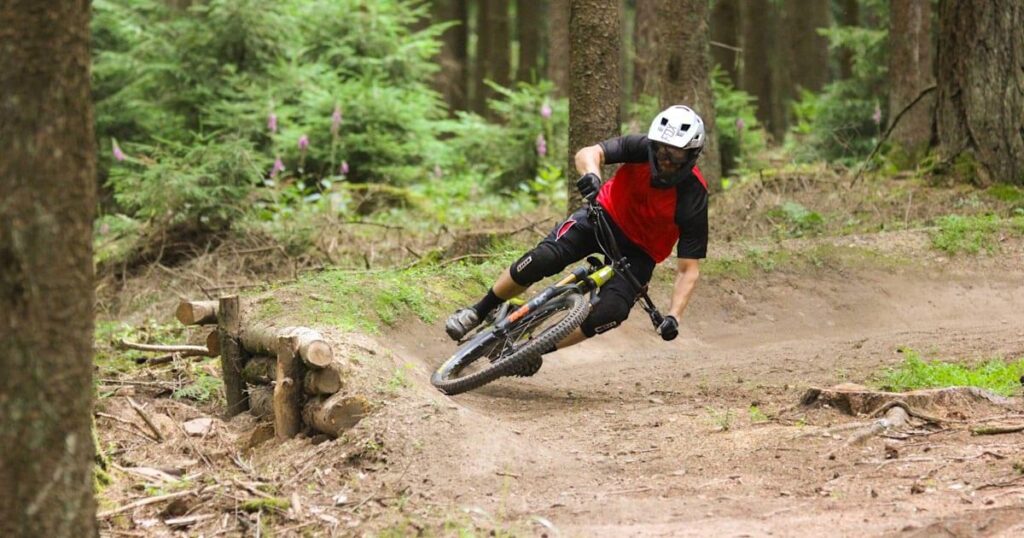
Definition of a Flow Trail
In the world of mountain biking, a Flow Trail (or simply “flow”) refers to a track designed to be:
- fluid,
- rhythmic,
- playful,
- intuitive to ride.
The principle is simple:
The bike should "flow" naturally into the terrain.
The rider then continued:
- the turns,
- the compressions,
- roller skates,
- the supports,
- sometimes the jumps,
with minimal braking and very little acceleration.
The word “flow” does not correspond to an official rating like green, blue, red or black.
He describes rather a design philosophy and a feeling of piloting.
A trail bike designed for the pleasure of riding
A good flow trail allows the rider to maintain:
- speed,
- rhythm,
- fluidity,
- a feeling of ease,
- immediate pleasure.
Unlike a very natural or technical trail, a flow trail generally seeks to avoid:
- the abrupt breaks,
- technical pitfalls,
- the inconsistent areas,
- permanent braking.
The terrain then becomes more “readable” and more mentally accessible.
Flow Trail vs Technical Trail
Two main types of trails are often contrasted:
The Flow Trail
- fluid,
- player,
- modern,
- pace,
- modified to maintain speed.
The technical trail
- roots,
- stones,
- natural slope,
- pins tightly packed,
- crossings,
- greater technical commitment.
Neither is “better”.
These are simply two very different riding experiences.
The best mountain biking areas often combine:
- natural mountain trails,
- and more accessible and fun flow trails.
The characteristics of a true Flow Trail
A homogeneous terrain
A flow trail typically has:
- few aggressive stones,
- few brittle roots,
- a relatively consistent grip,
- a rolling surface.
The goal is to maintain speed without being "taken out" of the rhythm.
Banked turns (berms)
Berms are practically the signature of modern flow trail running.
These banked turns allow:
- to maintain speed,
- to link the curves naturally,
- to generate driving pleasure,
- to make the trail more intuitive.
Rollers and compressions
The terrain plays a central role.
We often find:
- roller skates,
- waves of terrain,
- compressions,
- small ground movements that can be pumped.
The rider can then:
- generating speed without pedaling,
- play with the terrain,
- “Pumping” the supports like in BMX or pumptrack.
Jumps that are often accessible
Modern trail running often incorporates:
- small tables,
- rideable gaps,
- double secure,
- jump options.
The general idea remains:
- to offer fun,
- without making trail running reserved for experts.
The “flow” does not define the level
One important point:
A flow trail can be green, blue, red, or even black.
The flow describes the smoothness of the trail, not its difficulty.
Example: Green/blue flow
- moderate slope,
- limited speed,
- avoidable jumps,
- Ideal for exploring and families.
Example: Red Flow
- high speed,
- strong support,
- larger tables,
- Stronger physical engagement.
Why flow trails are exploding in modern bike parks
Flow trails have become the flagship product of modern mountain biking destinations.
For what ?
Because they offer:
- immediate pleasure,
- a feeling of rapid progress,
- broad accessibility,
- high customer satisfaction.
It's today:
- the favorite track of many recreational riders,
- the most profitable track in terms of visitor numbers,
- often the gateway to modern downhill mountain biking.
Major destinations such as:
- Whistler,
- Squamish,
- modern alpine resorts,
- the new generation of bike parks,
have developed this concept extensively.
The flow trail: a philosophy, more than just a trail
A true flow trail is not simply a “shaped” track.
He must:
- maintain a consistent speed,
- remain intuitive,
- avoid inconsistent traps,
- to allow movements to be linked together naturally.
Otherwise, the riders will probably talk about:
- jump line,
- of a prepared track,
- of DH,
- or simply a “shaped” track.
Flow is first and foremost a feeling.
How to describe a Flow Trail on a mountain biking website
Some examples of effective formulations:
Accessible version
A smooth and fun trail alternating between banked turns, rollers, and fast sections. Ideal for linking curves with rhythm and fluidity without requiring high technical skill.
More modern version
Modern singletrack flow trail, designed to prioritize speed, riding pleasure and fluidity.
Version geared towards the general public
A playful and fast track with many berms, clear terrain and natural transitions accessible to a wide audience.
Why is the flow so popular?
The success of the flow trail comes from a rare balance:
- sensation of speed,
- low stress,
- immediate pleasure,
- rapid progress,
- aesthetics of piloting.
Even an intermediate rider can feel like they are “riding well”.
And that's probably the whole strength of flow:
to make you want to do another run immediately.
